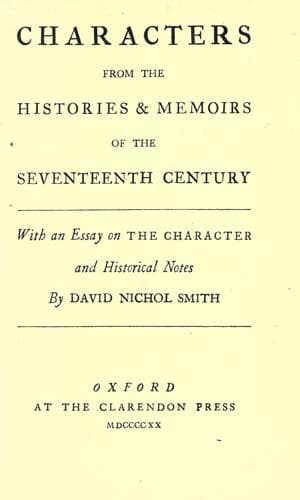
Characters from the Histories & Memoirs of the Seventeenth Century
History
Characters from the Histories & Memoirs of the Seventeenth Century
Great Britain -- Biography; Great Britain -- History -- Stuarts, 1603-1714
Baxter has an account of Vane in his Autobiography: 'He was the
Principal Man that drove on the Parliament to go too high, and act
too vehemently against the King: Being of very ready Parts, and very
great Subtilty, and unwearied Industry, he laboured, and not without
Success, to win others in Parliament, City and Country to his Way.
When the Earl of _Strafford_ was accused, he got a Paper out of his
Father's Cabinet (who was Secretary of State) which was the chief
Means of his Condemnation: To most of our Changes he was that _within_
the House, which _Cromwell_ was _without_. His great Zeal to drive
all into War, and to the highest, and to cherish the Sectaries, and
especially in the Army, made him above all Men to be valued by that
Party ... When Cromwell had served himself by him as his surest
Friend, as long as he could; and gone as far with him as their way lay
together, (_Vane_ being for a Fanatick Democracie, and _Cromwell_ for
Monarchy) at last there was no Remedy but they must part; and when
_Cromwell_ cast out the Rump (as disdainfully as Men do Excrements)
he called _Vane_ a Jugler' (_Reliquiæ Baxterianæ_, Lib. I, Part I, p.
75). This account occurs in Baxter's description of the sectaries who
were named after him 'Vanists'.
Clarendon and Baxter both lay stress on the element of the fanatic
in Vane's nature; and in a later section of the _History_ Clarendon
speaks of it emphatically: ... 'Vane being a man not to be described
by any character of religion; in which he had swallowed some of the
fancies and extravagances of every sect or faction, and was become
(which cannot be expressed by any other language than was peculiar to
that time) _a man above ordinances_, unlimited and unrestrained by any
rules or bounds prescribed to other men, by reason of his perfection.
He was a perfect enthusiast, and without doubt did believe himself
inspired' (vol. vi, p. 148).
Milton's sonnet, to Vane 'young in yeares, but in sage counsell old'
gives no suggestion of the fanatic:
besides to know
Both spirituall powre & civill, what each meanes
What severs each thou 'hast learnt, which few have don.
The bounds of either sword to thee wee ow.
Therfore on thy firme hand religion leanes
In peace, & reck'ns thee her eldest son.
There was much in Vane's views about Church and State with which
Milton sympathized; and the sonnet was written in 1652, before
Cromwell broke with Vane.
See also Pepys's _Diary_, June 14, 1662, and Burnet's _History of His
Own Time_, ed. Osmund Airy, vol. i, pp. 284-6.
Page 150, ll. 13, 14. _Magdalen College_, a mistake for Magdalen Hall,
of which Vane was a Gentleman Commoner; but he did not matriculate.
See Wood's _Athenæ Oxonienses_, ed. Bliss, vol. iii, col. 578.
l. 17. He returned to England in 1632; he had been in the train of the
English ambassador at Vienna.
Public-domain text, read in full here on John Shaqi.
Reviews
Reviews
No reviews yet
Be the first to share your thoughts on this work.
Elsewhere in the archive
Join the Discussion
Join the discussion
Sign in to leave a comment or review.
Sign InorCreate an account