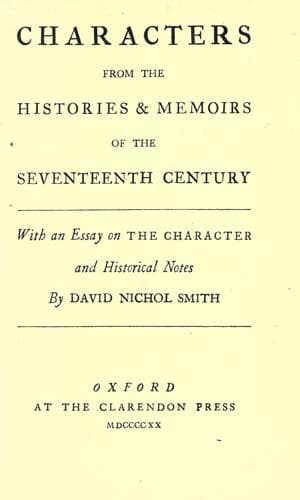
Characters from the Histories & Memoirs of the Seventeenth Century
History
Characters from the Histories & Memoirs of the Seventeenth Century
Great Britain -- Biography; Great Britain -- History -- Stuarts, 1603-1714
Fairfax's military capacity is certain, and his private virtues are
unquestioned. Writing in 1648, Milton credited him with the power to
settle the affairs of the nation. But Fairfax was not a politician. He
broke with Cromwell over the execution of the king, and in July 1650
retired into private life. Baxter, Warwick, and Clarendon all wrote
of him at a distance of time that showed his merits and limitations in
truer perspective.
Milton addressed him again when singing the praises of Bradshaw and
Cromwell and other Parliamentary leaders in his _Pro Populo Anglicano
Defensio Secunda_, 1654. As a specimen of a contemporary Latin
character, and a character by Milton, the passage is now quoted in
full:
'Sed neque te fas est præterire, _Fairfaxi_, in quo cum summa
fortitudine summam modestiam, summam vitæ sanctitatem, & natura &
divinus favor conjunxit: Tu harum in partem laudum evocandus tuo jure
ac merito es; quanquam in illo nunc tuo secessu, quantus olim Literni
Africanus ille Scipio, abdis te quoad potes; nec hostem solum, sed
ambitionem, & quæ præstantissimum quemque mortalium vincit, gloriam
quoque vicisti; tuisque virtutibus & præclare factis, jucundissimum &
gloriosissimum per otium frueris, quod est laborum omnium & humanarum
actionum vel maximarum finis; qualique otio cum antiqui Heroes, post
bella & decora tuis haud majora, fruerentur, qui eos laudare conati
sunt poetæ, desperabant se posse alia ratione id quale esset digne
describere, nisi eos fabularentur, coelo receptos, deorum epulis
accumbere. Verum te sive valetudo, quod maxime crediderim, sive
quid aliud retraxit, persuasissimum hoc habeo, nihil te a rationibus
reipublicæ divellere potuisse, nisi vidisses quantum libertatis
conservatorem, quam firmum atque fidum Anglicanæ rei columen ac
munimentum in successore tuo relinqueres' (ed. 1654, pp. 147-8).
Page 149, l. 9. The Self-denying Ordinance, discharging members of
Parliament from all offices, civil and military, passed both Houses on
April 3, 1645.
l. 18. He succeeded his father as third Lord Fairfax in 1648.
l. 21. See p. 118, ll. 8 ff.
41.
Clarendon, MS. Life, p. 103; _History_, Bk. III, ed. 1702, vol. i, pp.
148-9; ed. Macray, vol. i, pp. 247-9.
Public-domain text, read in full here on John Shaqi.
Reviews
Reviews
No reviews yet
Be the first to share your thoughts on this work.
Elsewhere in the archive
Join the Discussion
Join the discussion
Sign in to leave a comment or review.
Sign InorCreate an account