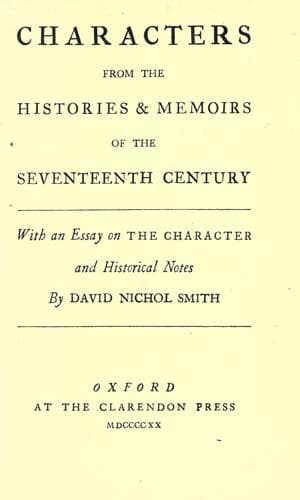
Characters from the Histories & Memoirs of the Seventeenth Century
History
Characters from the Histories & Memoirs of the Seventeenth Century
Great Britain -- Biography; Great Britain -- History -- Stuarts, 1603-1714
The Memoirs as a whole are the best picture we possess of a puritan
soldier and household of the seventeenth century. They were written by
his widow as a consolation to herself and for the instruction of
her children. To 'such of you as have not seene him to remember his
person', she leaves, by way of introduction, 'His Description.' It is
this passage which is here reprinted.
44, 45, 46, 47, 48.
Clarendon, MS. Life, pp. 212-15; _History_, Bk. VI, ed. 1703, vol. ii,
pp. 158-62; ed. Macray, vol. ii, pp. 541-8.
These five characters of Parliamentary peers follow one another at
the conclusion of Clarendon's sixth book, and are part of his 'view
of those persons who were of the King's Council, and had deserted his
service, and stayed in the Parliament to support the rebellion'.
A short passage on the Earl of Holland, between the characters of
Warwick and Manchester, is omitted.
Taken as a group, they are yet another proof of Clarendon's skill in
portraiture. Each character is clearly distinguished.
Page 159, ll. 7-10. His grandfather was William Cecil (1520-98), Lord
Burghley, the great minister of Elizabeth; his father was Robert Cecil
(1563-1612), created Earl of Salisbury, 1605, Secretary of State at
the accession of James.
Page 160, l. 9. He was member for King's Lynn in 1649, and
Hertfordshire in 1654 and 1656.
ll. 13-16. _Hic egregiis_, &c. Seneca, _De Beneficiis_, iv, cap. 30.
Page 161, ll. 3-19. 'Clarendon's view that Warwick was a jovial
hypocrite is scarcely borne out by other contemporary evidence. The
"jollity and good humour" which he mentions are indeed confirmed. "He
was one of the most best-natured and cheerfullest persons I have in
my time met with," writes his pious daughter-in-law (_Autobiography
of Lady Warwick_, ed. Croker, p. 27). Edmund Calamy, however, in his
sermon at Warwick's funeral, enlarges on his zeal for religion; and
Warwick's public conduct during all the later part of his career is
perfectly consistent with Calamy's account of his private life (_A
Pattern for All, especially for Noble Persons_, &c., 1658, 410, pp.
34-9).'--C.H. Firth, in the _Dictionary of National Biography_.
l. 13. _Randevooze_ (or _-vouze_, or _-vouce_, or _-vowes_) is a
normal spelling of _Rendezvous_ in the seventeenth century. The words
had been introduced into English by the reign of Elizabeth.
ll. 20-2. The proceedings are described at some length by Clarendon,
vol. ii, pp. 19-22, 216-23. Warwick was appointed Admiral by the
Parliament on July 1, 1642.
l. 23. The expulsion of the Long Parliament on April 20, 1653. A
thorough examination of all the authorities for the story of the
expulsion will be found in two articles by C.H. Firth in _History_,
October 1917 and January 1918.
ll. 24-5. Robert Rich, his grandson, married Frances, Cromwell's
youngest daughter, in November 1657, but died in the following
February, aged 23. See _Thurloe's State Papers_, vol. vi, p. 573.
Public-domain text, read in full here on John Shaqi.
Reviews
Reviews
No reviews yet
Be the first to share your thoughts on this work.
Elsewhere in the archive
Join the Discussion
Join the discussion
Sign in to leave a comment or review.
Sign InorCreate an account