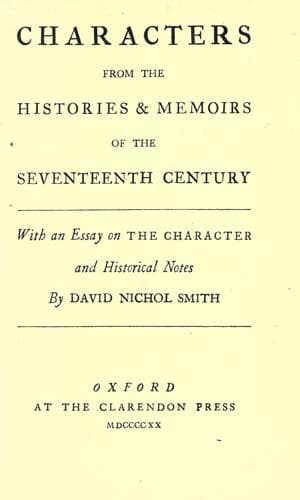
Characters from the Histories & Memoirs of the Seventeenth Century
History
Characters from the Histories & Memoirs of the Seventeenth Century
Great Britain -- Biography; Great Britain -- History -- Stuarts, 1603-1714
Page 162, l. 11. _in Spayne_, on the occasion of the proposed Spanish
match.
ll. 22-3. He resigned his generalship on April 2, 1645, the day before
the Self-Denying Ordinance was passed.
ll. 24 ff. His first wife was Buckingham's cousin, their mothers
being sisters. He married his second wife in 1626, before Buckingham's
death. He was five times married.
Page 163, l. 11. _his father_, Henry Montagu (1563-1642), created
Baron Montagu of Kimbolton and Viscount Mandeville, 1620, and Earl of
Manchester, 1628. By the favour of Buckingham he had been made Lord
Treasurer in 1620, but within a year was deprived of the office and
'reduced to the empty title of President of the Council'; see the
character (on the whole favourable) by Clarendon, vol. i, pp. 67-9.
l. 12. Manchester and Warwick are described by Clarendon as 'the two
pillars of the Presbyterian party' (vol. iv, p. 245).
Page 164, l. 16. He was accused with the five members of the House of
Commons, January 3, 1642. Cf. p. 123, l. 5.
l. 26. Elsewhere Clarendon says that Manchester 'was known to have all
the prejudice imaginable against Cromwell' (vol. iv, p. 245). He lived
in retirement during the Commonwealth, but returned to public life at
the Restoration, when he was made Lord Chamberlain.
This character may be compared with Clarendon's other character of
Manchester, vol. i, pp. 242-3, and with the character in Warwick's
_Mémoires_, pp. 246-7. Burnet, speaking of him in his later years,
describes him as 'A man of a soft and obliging temper, of no great
depth, but universally beloved, being both a vertuous and a generous
man'.
Page 165, ll. 6-9. See Clarendon, vol. i, p. 259.
l. ii. _that unhappy kingdome_. This was written in France.
ll. 20-5. Antony à Wood did not share Clarendon's scepticism about
Say's descent, though he shared his dislike of Say himself: see
_Athenæ Oxonienses_, ed. Bliss, vol. in, col. 546.
Page 166, ll. 25 ff. See Clarendon, ed. Macray, vol. i, pp. 333-5. Cf.
note p. 134, l. 3. After the King's execution he took little part in
public affairs, but at the Restoration he managed to be made a Privy
Councillor and Lord Privy Seal.
Clarendon has another and shorter character of Say, which supplements
the character here given, and deals mainly with his ecclesiastical
politics (vol. i, p. 241). He was thought to be the only member of the
Independent party in the House of Peers (vol. iii, p. 507).
Public-domain text, read in full here on John Shaqi.
Reviews
Reviews
No reviews yet
Be the first to share your thoughts on this work.
Elsewhere in the archive
Join the Discussion
Join the discussion
Sign in to leave a comment or review.
Sign InorCreate an account