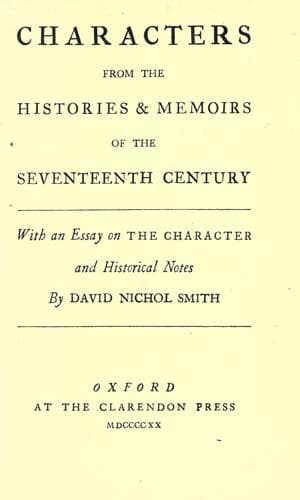
Characters from the Histories & Memoirs of the Seventeenth Century
History
Characters from the Histories & Memoirs of the Seventeenth Century
Great Britain -- Biography; Great Britain -- History -- Stuarts, 1603-1714
l. 17. John Wilmot (1647-80), second Earl of Rochester, son of Henry
Wilmot, first Earl (No. 32). Burnet knew him well and wrote his life,
_Some Passages of the Life and Death Of the Right Honourable John Earl
of Rochester_, 1680; 'which', says Johnson, 'the critick ought to read
for its elegance, the philosopher for its arguments, and the saint for
its piety' (_Lives of the Poets_, ed. G.B. Hill, vol. i, p. 222).
ll. 25 ff. The resemblance to Tiberius was first pointed out in print
in Welwood's _Memoirs_, p. 152, which appeared twenty-four years
before Burnet's _History_. But Welwood was indebted to Burnet. He
writes as if they had talked about it; or he might have seen Burnet's
early manuscript.
65.
Burnet's History of His Own Time. Vol. i. (pp. 94-5.)
The author of most of the characters in this volume himself deserves a
fuller character. The main portions of Burnet's original sketch (1683)
are therefore given here, partly by way of supplement, and partly to
illustrate the nature of Burnet's revision (1703):
'The great man with the king was chancellor Hyde, afterwards made Earl
of Clarendon. He had been in the beginning of the long parliament very
high against the judges upon the account of the ship-money and became
then a considerable man; he spake well, his style had no flaw in it,
but had a just mixture of wit and sense, only he spoke too copiously;
he had a great pleasantness in his spirit, which carried him sometimes
too far into raillery, in which he sometimes shewed more wit than
discretion. He went over to the court party when the war was like to
break out, and was much in the late king's councils and confidence
during the war, though he was always of the party that pressed the
king to treat, and so was not in good terms with the queen. The late
king recommended him to this king as the person on whose advices he
wished him to rely most, and he was about the king all the while that
he was beyond sea, except a little that he was ambassador in Spain; he
managed all the king's correspondences in England, both in the little
designs that the cavaliers were sometimes engaged in, and chiefly in
procuring money for the king's subsistence, in which Dr. Sheldon was
very active; he had nothing so much before his eyes as the king's
service and doated on him beyond expression: he had been a sort of
governor to him and had given him many lectures on the politics
and was thought to assume and dictate too much ... But to pursue
Clarendon's character: he was a man that knew England well, and was
lawyer good enough to be an able chancellor, and was certainly a very
incorrupt man. In all the king's foreign negotiations he meddled too
much, for I have been told that he had not a right notion of foreign
matters, but he could not be gained to serve the interests of other
princes. Mr. Fouquet sent him over a present of 10,000 pounds after
the king's restoration and assured him he would renew that every
Public-domain text, read in full here on John Shaqi.
Reviews
Reviews
No reviews yet
Be the first to share your thoughts on this work.
Elsewhere in the archive
Join the Discussion
Join the discussion
Sign in to leave a comment or review.
Sign InorCreate an account