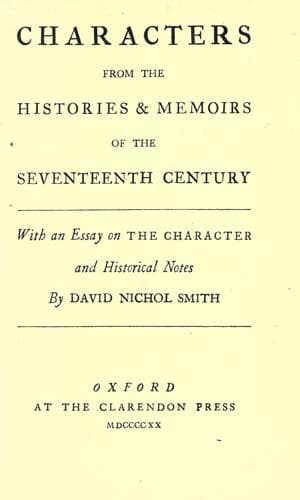
Characters from the Histories & Memoirs of the Seventeenth Century
History
Characters from the Histories & Memoirs of the Seventeenth Century
Great Britain -- Biography; Great Britain -- History -- Stuarts, 1603-1714
year, but though both the king and the duke advised him to take it he
very worthily refused it. He took too much upon him and meddled in
everything, which was his greatest error. He fell under the hatred
of most of the cavaliers upon two accounts. The one was the act of
indemnity which cut off all their hopes of repairing themselves of
the estates of those that had been in the rebellion, but he said it
was the offer of the indemnity that brought in the king and it was
the observing of it that must keep him in, so he would never let that
be touched, and many that had been deeply engaged in the late times
having expiated it by their zeal of bringing home the king were
promoted by his means, such as Manchester, Anglesey, Orrery, Ashley,
Holles, and several others. The other thing was that, there being an
infinite number of pretenders to employments and rewards for their
services and sufferings, so that the king could only satisfy some few
of them, he upon that, to stand between the king and the displeasure
which those disappointments had given, spoke slightly of many of them
and took it upon him that their petitions were not granted; and some
of them having procured several warrants from the secretaries for the
same thing (the secretaries considering nothing but their fees), he
who knew on whom the king intended that the grant should fall, took
all upon him, so that those who were disappointed laid the blame
chiefly if not wholly upon him. He was apt to talk very imperiously
and unmercifully, so that his manner of dealing with people was as
provoking as the hard things themselves were; but upon the whole
matter he was a true Englishman and a sincere protestant, and what
has passed at court since his disgrace has sufficiently vindicated him
from all ill designs' (_Supplement_, ed. Foxcroft, pp. 53-6).
There is a short character of Clarendon in Warwick's _Mémoires_, pp.
196-8; compare also Pepys's _Diary_, October 13, 1666, and Evelyn's
_Diary_, August 27, 1667, and September 18, 1683.
66.
Clarendon, MS. Life, pp. 638-9; _Continuation of the Life of Edward
Earl of Clarendon_, ed. 1759, pp. 51-2.
Page 226, l. 8. He was released from Windsor Castle in March 1660.
Compare Burnet's character, p. 228, ll. 2-4.
l. 19. _the Chancellour_, i.e. Clarendon himself.
Page 227, ll. 5 ff. John Middleton (1619-74), created Earl of
Middleton, 1656. He was taken prisoner at Worcester, but escaped to
France. As Lord High Commissioner for Scotland and Commander-in-chief,
he was mainly responsible for the unfortunate methods of forcing
episcopacy on Scotland.
William Cunningham (1610-64), ninth Earl of Glencairn, Lord Chancellor
of Scotland.
John Leslie (1630-81), seventh Earl and first Duke of Rothes,
President of the Council in Scotland; Lord Chancellor, 1667.
On the composition of the ministry in Scotland, compare Burnet, ed.
Osmund Airy, vol. i, pp. 199, ff.
67.
Burnet's History of His Own Time. Vol. i. (pp. 101-2.)
Public-domain text, read in full here on John Shaqi.
Reviews
Reviews
No reviews yet
Be the first to share your thoughts on this work.
Elsewhere in the archive
Join the Discussion
Join the discussion
Sign in to leave a comment or review.
Sign InorCreate an account