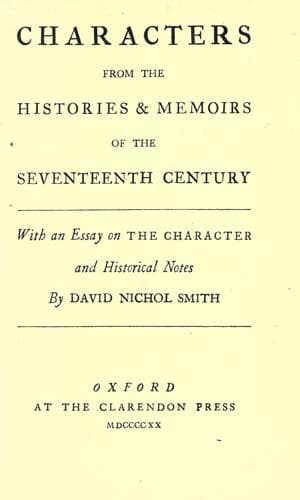
Characters from the Histories & Memoirs of the Seventeenth Century
History
Characters from the Histories & Memoirs of the Seventeenth Century
Great Britain -- Biography; Great Britain -- History -- Stuarts, 1603-1714
Page 252, l. 10. The following sentence is in the original manuscript
(folio 98) before 'But I owed': 'and if I have arrived at any faculty
of writing clear and correctly, I owe that entirely to them: for as
they joined with Wilkins in that Noble tho despised attempt at an
Universall Character, and a Philosophicall Language, they took great
pains to observe all the common errours of language in generall, and
of ours in particular: and in the drawing the tables for that work,
which was Lloyds province, he had looked further into a naturall
purity and simplicity of stile, than any man I ever knew: into
all which he led me, and so helpt me to any measure of exactnes
of writing, which may be thought to belong to me.' The sentence is
deleted in the transcript that was sent to the printer; but whether it
was deleted by Burnet himself, or by the editor, is uncertain. There
are other minor alterations in the same page of the transcript (p.
140).
The book referred to in the omitted passage is Wilkins's _Essay
Towards a Real Character And a Philosophical Language_, presented
to the Royal Society and published in 1668. Lloyd's 'continual
assistance' is acknowledged in the 'Epistle to the Reader'.
75.
Burnet's History of His Own Time. Vol. i. (pp. 168-70.)
Page 253, l. 23. He served under Turenne in four campaigns, 1652-5,
latterly as Lieutenant-General. His own account of these campaigns has
fortunately been preserved. It is a portion of the journal to which
Burnet refers. See _The Life of James the Second King of England,
etc., collected out of memoirs writ of his own hand.... Published from
the original Stuart manuscripts in Carlton-House_, edited by James
Stanier Clarke, 2 vols, 1816.
Page 254, l. 20. After the surrender at Oxford on June 24, 1646, James
was given into the charge of the Earl of Northumberland and confined
at St. James's. See _Life_, ed. J.S. Clarke, vol. i, pp. 30-1, and
Clarendon, vol. iv, pp. 237, and 326-8.
Page 255, l. 3. Richard Stuart (1594-1651), 'the dean of the King's
chapel, whom his majesty had recommended to his son to instruct him in
all matters relating to the Church' (Clarendon, vol. iv, p. 341). See
Wood's _Athenæ Oxonienses_, ed. Bliss, vol. iii, cols. 295-8, and John
Walker's _Sufferings of the Clergy_, Pt. II, p. 48.
ll. 6-8. The autograph reads (fol. 87): 'He said that a Nun had
advised him to pray every day, that if he was not in the right way
that God would set him right, did make a great impression on him.' The
transcript (p. 127) agrees with the print.
ll. 27-9. James definitely joined the Roman church at the beginning of
1669: see _Life_, ed. J.S. Clarke, vol. i, p. 440.
Page 256, l. 3. As High Admiral he defeated the Dutch at Lowestoft,
1665, and Southwold Bay, 1672. Compare Dryden's _Annus Mirabilis_, ll.
73-4:
Victorious _York_ did first, with fam'd success,
To his known valour make the _Dutch_ give place;
Public-domain text, read in full here on John Shaqi.
Reviews
Reviews
No reviews yet
Be the first to share your thoughts on this work.
Elsewhere in the archive
Join the Discussion
Join the discussion
Sign in to leave a comment or review.
Sign InorCreate an account