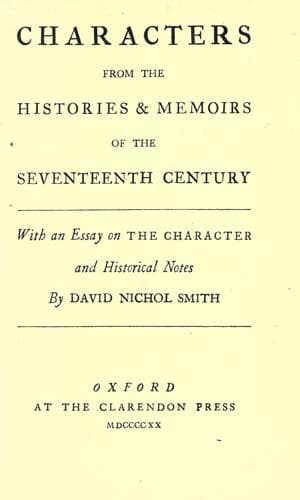
Characters from the Histories & Memoirs of the Seventeenth Century
History
Characters from the Histories & Memoirs of the Seventeenth Century
Great Britain -- Biography; Great Britain -- History -- Stuarts, 1603-1714
The Life of Lord Keeper Guilford is invaluable as a picture of the
bench and bar under Charles II and James II.
Page 240, l. 6. Sir Francis Pemberton (1625-97), Lord Chief Justice,
1681, removed from the King's Bench, 1683, 'near the time that the
great cause of the _quo warranto_ against the city of London was to be
brought to judgment in that court.' North had just described him as a
judge.
Page 241, l. 1. Compare Scott's _Monastery_, ch. xiv: '"By my troggs,"
replied Christie, "I would have thrust my lance down his throat."'
'Troggs' is an altered form of 'Troth'. It appears to be Scottish
in origin; no Southern instance is quoted in Wright's _Dialect
Dictionary_. Saunders may have learned it from a London Scot.
l. 22. Sir John Maynard (1602-90), 'the king's eldest serjeant, but
advanced no farther'. Described by North, ed. 1890, p. 149; also p.
26: 'Serjeant Maynard, the best old book-lawyer of his time, used to
say that the law was _ars bablativa_'.
l. 30. Sir Matthew Hale (1609-76), Lord Chief Justice of the King's
Bench, described by North, pp. 79 ff. Burnet wrote _The Life and Death
of Sir Matthew Hale_, 1682.
Page 243, l. 5. The action taken by the Crown in 1682 contesting the
charter of the city of London. Judgement was given for the Crown. See
_State Trials_, ed. 1810, vol. viii, 1039 ff., and Burnet, ed. Airy,
vol. ii, pp. 343 ff., and compare Hallam, _Constitutional History_,
ch. xii, ed. 1863, pp. 453-4.
74.
Burnet's History of His Own Time. Vol. i. (pp. 186-91).
This passage brings together ten of the great divines of the century.
It would be easy, as critics have shown, to name as many others, such
as Jeremy Taylor, Sanderson, Sheldon, Cosin, Pearson, and South. But
Burnet is mainly concerned with the men who in his opinion had the
greatest influence during the time of which he is writing, and who
were known to him personally. By way of introduction he speaks of
the Cambridge Platonists under whom his great contemporaries had been
formed. Incidentally he expresses his views on Hobbes's _Leviathan_,
and he concludes with a valuable account of the reform in preaching.
The passage as a whole is an excellent specimen of Burnet's method and
style.
Page 246, ll. 6, 7. John Owen (1616-83), made Dean of Christ Church by
Cromwell in 1651, Vice-Chancellor of the University, 1652-8, deprived
of the Deanery, 1659. Thomas Goodwin (1600-80), President of Magdalen
College, 1650-60, likewise one of the Commission of Visitors to the
University appointed by the Parliament. Both were Independents. See
H.L. Thompson, _Christ Church_ (College Histories), 1900, pp. 69, 70;
and H.A. Wilson, _Magdalen College_, 1899, pp. 172-4.
Page 248, l. 5. Simon Episcopius, or Bischop (1583-1643), Dutch
theologian and follower of Arminius: see p. 101, l. 3, note.
Page 249, l. 12. _Irenicum_. _A Weapon-Salve for the Churches Wounds_,
published 1661.
Public-domain text, read in full here on John Shaqi.
Reviews
Reviews
No reviews yet
Be the first to share your thoughts on this work.
Elsewhere in the archive
Join the Discussion
Join the discussion
Sign in to leave a comment or review.
Sign InorCreate an account