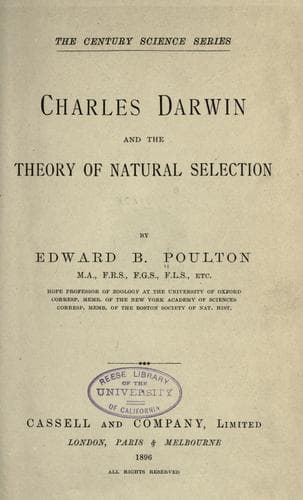
Charles Darwin and the Theory of Natural SelectionPoulton, Edward Bagnall, Sir
Science
Charles Darwin and the Theory of Natural Selection
Poulton, Edward Bagnall, Sir
Darwin, Charles, 1809-1882; Natural selection
CHAPTER XXIII.
DESCENT OF MAN--EXPRESSION OF EMOTIONS--EARTH-WORMS (1871–81).
The work on “The Descent of Man” was begun as soon as Darwin had sent
the manuscript of “Animals and Plants” to the printers, although
notes on the subject had been collected from time to time during the
previous thirty years--in fact, ever since Darwin had come to definite
conclusions on evolution.
The book was published February 24th, 1871, but, as in the case of
his other publications, continuous work upon the manuscript had been
impossible. The volume attracted great interest, and 5,000 copies were
printed in 1871 in addition to the first 2,500.
The full title of the book is “The Descent of Man, and Selection in
Relation to Sex,” and, as this title almost implies, it is made up of
two distinct works, which might well have been issued separately. The
first part, dealing with man, is far shorter than the other. Darwin
had from the first considered that his theory of evolution by natural
selection would involve man as well as the other animals, and, that no
one might accuse him of want of candour, he had said in the “Origin”
that by this work “light would be thrown on the origin of man and his
history.” But he was anxious to justify this statement, which was, of
course, distasteful to very many in those days, by a most complete
treatment of the subject.
[Sidenote: DESCENT OF MAN.]
He opens this part of the work, which he calls “The Descent or Origin
of Man,” by discussing the structures which are common to man and
animals, including those which are represented in man in a rudimentary
state, and by showing the similarity of the phases through which man
and animals pass during their embryological development.
Having thus shown that man was probably descended from some lower
form, he considers the mode by which the process was effected, showing
that man possesses variability in body and mind, and is, like other
animals, subject to all the laws of inheritance and variation, and to
the direct action of surrounding conditions, and to the effect of the
use and disuse of parts, and that his rate of increase is such as to
render a large amount of extermination inevitable. In other words, he
presents the same facilities for the operation of natural selection as
those presented by other animals. The points in which man differs from
other animals are then considered in relation to their possible origin
by natural selection. The differences and resemblances between the mind
of man and animals are discussed in much detail, and the origin of the
former through natural selection is defended. This part concludes with
the consideration of the position of man in the animal series, his
birthplace and antiquity, and with an account of the formation of races.
Public-domain text, read in full here on John Shaqi.
Reviews
Reviews
No reviews yet
Be the first to share your thoughts on this work.
Elsewhere in the archive
Join the Discussion
Join the discussion
Sign in to leave a comment or review.
Sign InorCreate an account