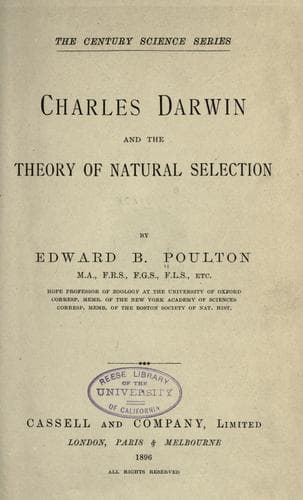
Charles Darwin and the Theory of Natural SelectionPoulton, Edward Bagnall, Sir
Science
Charles Darwin and the Theory of Natural Selection
Poulton, Edward Bagnall, Sir
Darwin, Charles, 1809-1882; Natural selection
In the second part Darwin brings forward a large body of evidence in
favour of his hypothesis of sexual selection--viz. the view that, in
the higher animals, some alteration, especially of the secondary sexual
characters, is produced by the preferences and rejections of the sex
which is sought by the other. Such results are commonly found in the
males as a result of the preferences of the females accumulated through
countless generations; but in some species the females court the males,
and are themselves subject to the same process of improvement by
selection.
Opinion is still divided on this most interesting question. Wallace,
more convinced than ever as to the efficiency and scope of natural
selection, after first doubting, has finally come to reject sexual
selection altogether. Probably the majority of naturalists are
convinced by Darwin’s arguments and his great array of facts that
the principle of sexual selection is real, and accounts for certain
relatively unimportant features in the higher animals, and they further
accept Darwin’s opinion that its action has always been entirely
subordinate to natural selection.
A brief third part considers sexual selection in relation to man.
Darwin says, in his “Autobiography,” that sexual selection and “the
variation of our domestic productions, together with the causes and
laws of variation, inheritance, and the intercrossing of plants, are
the sole subjects which I have been able to write about in full, so as
to use all the materials which I have collected.”
[Sidenote: EXPRESSION OF EMOTIONS.]
“The Expression of the Emotions,” at first intended as a chapter of the
“Descent,” was begun, only two days after the proofs of the latter had
been corrected, on January 15th, 1871. The book was published in the
autumn of the following year; the edition consisted of 7,000 copies,
and 2,000 were printed at the end of the year; and this, we are told,
was a mistake, as it prevented the appearance of a second edition, with
notes and corrections, during the author’s lifetime. Darwin had begun
to take notes on this subject when his first child was born, December
27th, 1839, for he tells us that, even then, he felt convinced “that
the most complex and fine shades of expression must all have had a
gradual and natural origin.”--(“Autobiography.”)
In this work Darwin argues with great wealth of illustration and the
record of numberless interesting observations, that the movements of
expression are to be explained by three principles. The first of these
is that movements made in gratifying some desire become by repetition
so habitual that the slightest feeling of desire leads to their
performance, however useless they may then be. The second principle
is that of antithesis--“the habit of voluntarily performing opposite
movements under opposite impulses.” The third principle is “the direct
action of the excited nervous system on the body, independently of the
will, and independently, in large part, of habit.”
Public-domain text, read in full here on John Shaqi.
Reviews
Reviews
No reviews yet
Be the first to share your thoughts on this work.
Elsewhere in the archive
Join the Discussion
Join the discussion
Sign in to leave a comment or review.
Sign InorCreate an account