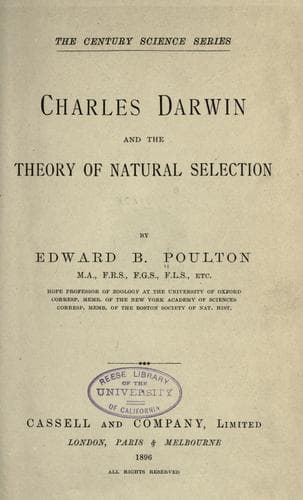
Charles Darwin and the Theory of Natural SelectionPoulton, Edward Bagnall, Sir
Science
Charles Darwin and the Theory of Natural Selection
Poulton, Edward Bagnall, Sir
Darwin, Charles, 1809-1882; Natural selection
In 1879 he wrote and published a life of his grandfather, Erasmus
Darwin, as “a preliminary notice” to the English translation of E.
Krause’s Life; but Darwin’s contribution forms the larger part of the
volume.
CHAPTER XXIV.
BOTANICAL WORKS (1862–86).
Darwin’s botanical works are referred to separately, and receive more
systematic treatment than the others, in the great “Life and Letters.”
They form, together with the botanical letters, the subject of the
seventh to the twelfth chapters in the last volume. It will therefore
be unnecessary to treat them in any detail, although they form some of
the most important and interesting of all his biological investigations.
_Fertilisation of flowers._--“The Fertilisation of Orchids” was the
first published of the botanical works, appearing in 1862, followed
by a second and greatly altered edition in 1877. The object of the
work “is to show that the contrivances by which orchids are fertilised
are as varied and almost as perfect as any of the most beautiful
adaptations in the animal kingdom; and secondly, to show that these
contrivances have for their main object the fertilisation of the
flowers with pollen brought by insects from a distant plant.” Even
in 1837 Darwin had written in his note-book, “Do not plants which
have male and female organs together [_i.e._ in the same flower] yet
receive influence from other plants? Does not Lyell give some argument
about varieties being difficult to keep [true] on account of pollen
from other plants? Because this may be applied to show all plants do
receive intermixture.” (Quoted in the “Life and Letters.”) In 1841,
Robert Brown, the distinguished botanist, advised Darwin to read
Sprengel’s “Secret of Nature Displayed” (Berlin, 1793). The result was
to encourage and assist Darwin in his work on fertilisation of flowers
by insects, and to bring about the first due recognition of Sprengel’s
merits, long after his death.
“_The Effects of Cross- and Self-fertilisation in the Vegetable
Kingdom._”--This work has a very direct bearing on that last mentioned.
Darwin speaks in the Autobiography “of having come [in 1839] to the
conclusion in my speculations on the origin of species, that crossing
played an important part in keeping specific forms constant.” Later
on he came to see that the advantage of crossing is more direct,
and results from the greater vigour of the offspring over those of
self-fertilised plants. The object of this work, published in 1876,
was to prove this point by experimental evidence of sufficient amount,
and to show in numerous cases, by measurements of height or weight,
or by counting the number of seeds produced, that cross-fertilisation
invariably tends towards the greater vigour of offspring.
Hence the motive cause for the marvellous adaptations by which
cross-fertilisation is ensured was supplied.
[Sidenote: FORMS OF FLOWERS.]
Public-domain text, read in full here on John Shaqi.
Reviews
Reviews
No reviews yet
Be the first to share your thoughts on this work.
Elsewhere in the archive
Join the Discussion
Join the discussion
Sign in to leave a comment or review.
Sign InorCreate an account