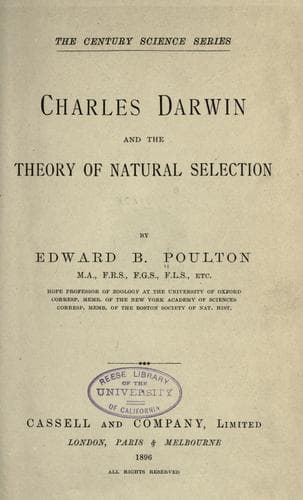
Charles Darwin and the Theory of Natural SelectionPoulton, Edward Bagnall, Sir
Science
Charles Darwin and the Theory of Natural Selection
Poulton, Edward Bagnall, Sir
Darwin, Charles, 1809-1882; Natural selection
By showing that the expressions of emotions could thus be explained
naturally, Darwin undermined the position taken up by Sir Charles Bell,
that the muscles used in producing expression were created for this
special end.
In 1876 he re-commenced geological work, bringing out his previous
works on “Volcanic Islands,” and on “South America,” as a single
volume. In this year too he wrote (November 16th) a most interesting
letter to James Geikie, offering an explanation of the large stones
standing in an upright position in the drift of the south of England.
He had noticed the same thing with the flints in the red clay left
upon the chalk as a residuum after the action of solvent agencies
on the latter. This position he explained was due to the movement
following the slow subsidence of parts of the clay as the chalk beneath
dissolved, the flints arranging themselves along the lines of least
resistance. This suggested to him the view that the flints in the drift
are to be explained by the subsidence, during the warmer climate which
followed the glacial period, of alternate layers of snow and drift
accumulated during the winters and summers respectively, of the cold
period itself.
This interesting view will, Geikie believes, come to be accepted as the
truth.
[Sidenote: WORK OF EARTH-WORMS.]
The book upon “The Formation of Vegetable Mould Through the Action
of Worms,” must be included among his geological works, although it
contains a great many observations of deep zoological interest. It
has been stated already that he wrote a paper on this subject for
the Geological Society in 1838. In 1877 he studied the mode by which
Roman remains gain their protective covering of mould; again towards
the end of 1880 he began systematically to prepare the book, which
was published on October 10th of the following year. It was extremely
successful, 8,500 copies being sold in three years.
This interesting work affords a good illustration of the tremendous
results obtained, even in a moderate time, by an immense number of
workers all using their powers in one direction. Each single earth-worm
swallows earth in the excavation of its burrow and for the nutriment
it contains, the waste material being ejected as “castings” at the
surface, and as a lining to the burrow. But although the amount of
earth thus swallowed by a single worm is not large, worms are so
numerous that “the whole of the superficial mould ... has passed, and
will again pass, every few years through the bodies of worms.” The
result of this unceasing transport of the deeper mould to the surface
is shown to be the burial of stones, either singly or in layers (as in
paths), the covering and consequent protection of ancient buildings,
and the preparation of soil for plants. In addition to this, the
geological denuding agencies are assisted by the manner in which the
deeper soil is brought into a position in which it is exposed to their
action.
Public-domain text, read in full here on John Shaqi.
Reviews
Reviews
No reviews yet
Be the first to share your thoughts on this work.
Elsewhere in the archive
Join the Discussion
Join the discussion
Sign in to leave a comment or review.
Sign InorCreate an account