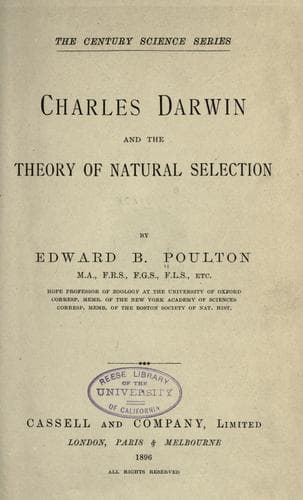
Charles Darwin and the Theory of Natural SelectionPoulton, Edward Bagnall, Sir
Science
Charles Darwin and the Theory of Natural Selection
Poulton, Edward Bagnall, Sir
Darwin, Charles, 1809-1882; Natural selection
“_Climbing Plants._”--The subject of this volume was published as a
paper before the Linnean Society in 1864. After being corrected, the
material was brought out as a volume in 1875. Darwin, as he tells us in
the Autobiography, was first led to study the subject by a paper by Asa
Gray, which appeared in 1858 (Proc. Amer. Acad. of Arts and Sciences).
Writing to Asa Gray, August 4th, 1863, he said, “My present hobby-horse
I owe to you, viz. the tendrils.” One of the most interesting results
brought forward in this work is the fact that the upper growing part
of a twining stem bends to one side and then travels slowly round,
between two and three hours being required for each revolution, in the
case of the hop growing in a room and observed at the period of most
active movement. The circle swept at the 27th revolution was 19 inches
in diameter. In the case of this plant the three youngest internodes
(or joints), and never less than two of them, were concerned in the
movement; “by the time the lower one ceased to revolve, the one above
was in full action, with a terminal internode just commencing to move.”
The object of this movement is to strike some object round which
the plant may twine. A much grander example was seen in _Ceropegia
Gardnerii_, in which three long internodes and two short ones swept a
circle over 5 feet in diameter, “at the rate of 32 or 33 inches per
hour, in search of some object round which to twine.” The stem of the
plant is not in the least twisted by this movement. Nearly all of the
great divisions of twining plants, leaf-climbers, and tendril-bearers
“have the same remarkable power of spontaneously revolving.”
[Sidenote: MOVEMENT IN PLANTS.]
“_The Power of Movements in Plants_” was published on November 6th,
1880. It embodies a vast amount of work carried on in conjunction with
Francis Darwin. This volume bears a very direct relation to that last
mentioned, as Darwin has explained in his Autobiography:--
“In accordance with the principle of evolution it was impossible
to account for climbing plants having been developed in so many
widely different groups unless all kinds of plants possess
some slight power of movement of an analogous kind. This I
proved to be the case; and I was further led to a rather wide
generalisation, viz. that the great and important classes of
movements, excited by light, the attraction of gravity, &c., are
all modified forms of the fundamental movement of circumnutation.”
An extreme example of circumnutation has already been described in the
revolving movements of the youngest parts of the stem of a twining
plant.
Public-domain text, read in full here on John Shaqi.
Reviews
Reviews
No reviews yet
Be the first to share your thoughts on this work.
Elsewhere in the archive
Join the Discussion
Join the discussion
Sign in to leave a comment or review.
Sign InorCreate an account