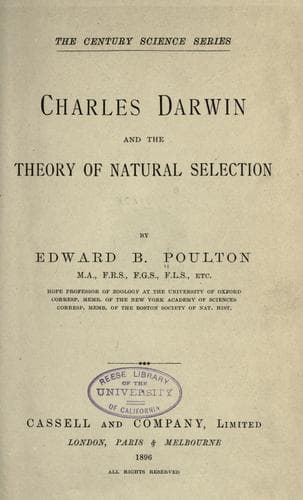
Charles Darwin and the Theory of Natural SelectionPoulton, Edward Bagnall, Sir
Science
Charles Darwin and the Theory of Natural Selection
Poulton, Edward Bagnall, Sir
Darwin, Charles, 1809-1882; Natural selection
The work evoked very great interest in this country, but was severely
criticised by certain German botanists. The immense number of new
observations must always have a very high value, whatever be the fate
of the general conclusions, concerning which it may be remarked that
Darwin’s conclusions have often been criticised before, but time has
shown that he was right.
“_Insectivorous Plants_” was published July 2nd, 1875, but I consider
it last, as the subject stands somewhat apart from the rest of his
botanical works. The subject was suggested to him by noticing the
insects caught by the leaves of the Sun-dew (_Drosera_) near Hartfield.
He then studied in great detail the causes of the movement, and the
sensitiveness of the gland-tipped hairs, finding that a piece of hair
weighing 1/78000 of a grain causes one of them to curve inwards, and
alters “the condition of the contents of every cell in the foot-stalk
of the gland.”
The greater part of the work deals with the experiments on _Drosera_,
which were extremely numerous and detailed. The remainder treats of
other insectivorous plants, such as Dionæa, Pinguicula, Utricularia,
etc. The methods of capture, the movements of the plants under the
stimulus supplied by the living insect (or other animal), and the
resulting changes in the plant-cells were not the only points studied.
He also investigated the digestive secretion and its action upon the
food absorbed by the leaves.
CHAPTER XXV.
LETTERS FROM DARWIN TO PROFESSOR MELDOLA (1871–82).
By the kindness of my friend Professor Meldola, and the courtesy of
Mr. Francis Darwin, I am enabled to publish for the first time a
series of letters written by Charles Darwin to the former. The whole
series consists of 33 letters, written between January 28th, 1871, and
February 2nd, 1882, only a few weeks before his death.
When we remember the immense amount of correspondence with which Darwin
had to cope, the constant attention required by his investigations and
publications, and the state of his health, it is deeply interesting
to read these letters, written with such unfailing courtesy, to a
younger worker in the lines that he had suggested, and who was thereby
stimulated and encouraged to undertake the researches which are now so
well known.
Reading these letters and remembering the circumstances of the writer,
we can understand how it is that, although ill-health prevented his
presence on occasions at which the younger scientific men are wont
to meet--although he was known to but few of them--nevertheless the
charm of his noble and generous nature was a most potent force in
influencing and attracting men; and it was this, no less than his
epoch-making discoveries, which has made it one of the chief regrets of
many a scientific worker that he never saw Charles Darwin.
[Sidenote: LETTERS.]
The correspondence was opened by a letter from Meldola informing Darwin
of a case of hexadactylism in a man at Turnham Green.
“_Jan. 28 [1871]._
Public-domain text, read in full here on John Shaqi.
Reviews
Reviews
No reviews yet
Be the first to share your thoughts on this work.
Elsewhere in the archive
Join the Discussion
Join the discussion
Sign in to leave a comment or review.
Sign InorCreate an account