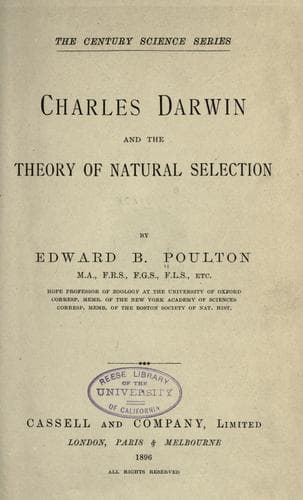
Charles Darwin and the Theory of Natural SelectionPoulton, Edward Bagnall, Sir
Science
Charles Darwin and the Theory of Natural Selection
Poulton, Edward Bagnall, Sir
Darwin, Charles, 1809-1882; Natural selection
“DEAR SIR--The point to which you refer seems to me a very
difficult one. 1^{st} the comparison of the amount of variability
in itself would be difficult. 2^{ndly} of all characters,
colour seems to be the most variable, as we see in domesticated
productions. (3) I fully agree that selection if long continued
gives fixity to characters. We see the reverse of this in the
great variability of fancy races, now being selected by man.
But to give fixity, selection must be continued for a very long
period: pray consider on this head what I have said in the Origin
about the variability of characters developed in an extraordinary
manner, in comparison with the same characters in allied species.
The selection must also be for a definite object, and not for
anything so vague as beauty, or for the superiority of one male
in its weapons over another male, which can in like manner be
modified. This at least seems to me partly to account for the
general variability of secondary sexual characters. In the case
of mimetic insects, there is another element of doubt, as the
imitated form may be undergoing change which will be followed by
the imitating form. This latter consideration seems to me, as
remarked in my ‘Descent of Man,’ to throw much light on how the
process of imitation first began.
“I enclose a letter from Fritz Müller which I think is well worth
reading, and which please to return to me.
“You will see he lays much stress on the difficulty of several
remotely allied forms all imitating some one species. Mr. Wallace
did not think that there was so much weight in this objection
as I do. It is, however, possible that a few species in widely
different groups, before they had diverged much, should have
accidentally resembled, to a certain extent, some one species.
You will also see in this letter a strange speculation, which I
should not dare to publish, about the appreciation of certain
colours being developed in those species which frequently behold
other forms similarly ornamented. I do not feel at all sure that
this view is as incredible as it may at first appear. Similar
ideas have passed through my mind when considering the dull
colours of all the organisms which inhabit dull-coloured regions,
such as Patagonia and the Galapagos Is. I suppose you know Mr.
Riley’s excellent essay on mimicry in the last report on the
noxious insects of Missouri or some such title.
“I hope your work may be in every way successful.
“I remain, dear Sir, yours faithfully,
“CHARLES DARWIN.”
The next letter deals with mimetic resemblance:--
“_Mar. 28, 1872._
“Down.
Public-domain text, read in full here on John Shaqi.
Reviews
Reviews
No reviews yet
Be the first to share your thoughts on this work.
Elsewhere in the archive
Join the Discussion
Join the discussion
Sign in to leave a comment or review.
Sign InorCreate an account