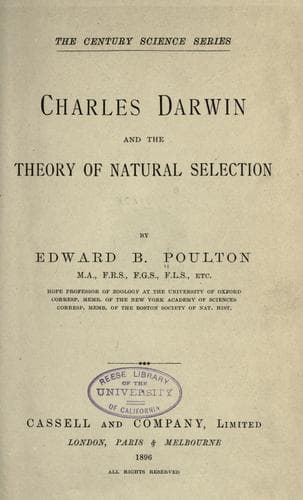
Charles Darwin and the Theory of Natural SelectionPoulton, Edward Bagnall, Sir
Science
Charles Darwin and the Theory of Natural Selection
Poulton, Edward Bagnall, Sir
Darwin, Charles, 1809-1882; Natural selection
“DEAR SIR--I thank you for your information on various subjects.
The point to which you allude seems to me very obscure, and I
hardly venture to express an opinion on it. My first impression
is that the colour of an imitating form might be modified to
any extent without any tendency being given to the retention
of ancient structural peculiarities. The difficulty of the
subject seems to me to follow from our complete ignorance of the
causes which have led to the generic differences between the
imitating and imitated forms. The subject however seems worth
investigating. If the imitator habitually lives in company with
the imitated, it would be apt to follow in some respects the same
habits of life, and this perhaps would lead to the retention or
acquirement of some of the same structural characters.
“I wish you all success in your essay, and remain, dear Sir,
yours very faithfully,
“CH. DARWIN.”
The next very brief letter, acknowledging the receipt of a note, was
written from Down, March 26th, 1873. It contained some sympathetic
remarks upon the progress of Meldola’s work upon Mimicry. In the
succeeding letter, printed below, we find a very definite statement of
opinion as to the _rôle_ of monstrosities in evolution:--
“_Aug. 13th_ [1873].
“Down.
“DEAR SIR--I am much obliged for your present which no doubt I
shall find at Down on my return home....
“I am sorry to say that I cannot answer your question; nor do
I believe that you could find it anywhere even approximately
answered. It is very difficult or impossible to define what is
meant by a larger variation. Such graduate into monstrosities
or generally injurious variations. I do not myself believe that
these are often or ever taken advantage of under nature. It is a
common occurrence that _abrupt_ and considerable variations are
transmitted in an unaltered state, or not at all transmitted,
to the offspring or to some of them. So it is with tailless or
hornless animals, and with sudden and great changes of colour in
flowers.--I wish I could have given you any answer.
“Dear Sir, yours very faithfully,
“CH. DARWIN.”
The succeeding three letters show Darwin’s scrupulous care as regards
the publication, although with every acknowledgment, of the results
obtained by others. They refer to a letter from Fritz Müller which
he had forwarded to Meldola. The latter had written to ask Darwin’s
permission and advice as to the inclusion of some of F. Müller’s
observations in his most interesting paper, “Entomological Notes
bearing on Evolution” (_Ann. and Mag. Nat. Hist._, 1878, 5th series,
Vol. I. p. 155), which he was then preparing:--
“_Sept. 14, 1877._
Public-domain text, read in full here on John Shaqi.
Reviews
Reviews
No reviews yet
Be the first to share your thoughts on this work.
Elsewhere in the archive
Join the Discussion
Join the discussion
Sign in to leave a comment or review.
Sign InorCreate an account