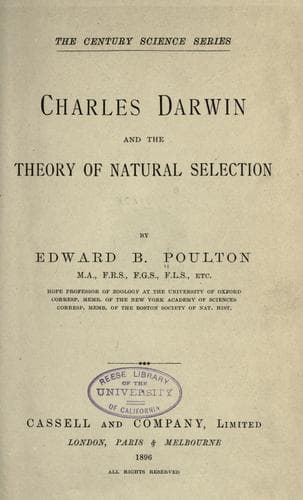
Charles Darwin and the Theory of Natural SelectionPoulton, Edward Bagnall, Sir
Science
Charles Darwin and the Theory of Natural Selection
Poulton, Edward Bagnall, Sir
Darwin, Charles, 1809-1882; Natural selection
The “green silk” referred to some specimens of coal-tar colours sent
to show Darwin what modern chemistry had been able to accomplish in
the way of artificial colouring matters. They were at that time of
particular interest in connection with a discussion which had arisen
in Bryanston Street about the so-called “æsthetic” school, which
had become rather predominant at the period, and which affected an
abhorrence of all brilliant colouring, in spite of the circumstance
that nature abounds in the most gorgeous hues, especially in the
tropics.
The next letter refers to the adoption of the word “phyletic” in the
translation of Weismann.
“_Dec. 14_ [1878].
“Down.
“MY DEAR SIR,--I am very glad that you are making good progress
with the book.--You could not apply to a worse person than myself
on any philological question. I presume that ‘phyletische’ has
been adopted or modified from Häckel. As the latter uses the
word, it has nearly the sense of genealogical. It always applies
to the lines of descent, and therefore differs somewhat from
‘innate’; for an inherited character, though derived from the
father alone or only a single generation, would be innate in the
child. I should think ‘phyletic’ would do very well, if you gave
the German word and an explanation, in a foot-note.
“There has been a delay in answering your letter, but I have just
heard from my son who is away from home, and he says that he is
sorry but he cannot well spare the time to lecture.
“My dear Sir, yours very faithfully,
“CH. DARWIN.”
Then followed two letters (January 20th, and February 7th, 1879), the
first written when Darwin was sending a number of _Kosmos_; the second
referring to it and other papers, and asking that his name should be
put down as a subscriber to the forthcoming translation of Weismann.
Later on the number of _Kosmos_ for May, 1879, was sent, containing
(p. 100) Fritz Müller’s paper “_Ituna_ and _Thyridia_.” This paper,
although it did not attract sufficient attention at the time, was of
the highest importance in relation to the theory of mimicry, as Meldola
at once perceived.
Public-domain text, read in full here on John Shaqi.
Reviews
Reviews
No reviews yet
Be the first to share your thoughts on this work.
Elsewhere in the archive
Join the Discussion
Join the discussion
Sign in to leave a comment or review.
Sign InorCreate an account