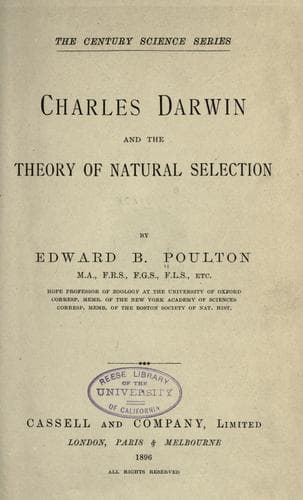
Charles Darwin and the Theory of Natural SelectionPoulton, Edward Bagnall, Sir
Science
Charles Darwin and the Theory of Natural Selection
Poulton, Edward Bagnall, Sir
Darwin, Charles, 1809-1882; Natural selection
Bates in his epoch-making paper in the Transactions of the Linnean
Society (Vol. XXIII. 1862) had founded the theory of mimicry.
Those rarer forms which have diverged from their near allies and,
in superficial appearance, approached some distantly related, but
abundant, species inhabiting the same tract have been, according to
Bates’s theory, benefiting themselves in the struggle for existence.
The mimicked species are, he suggested, abundant because they possess
some special means of protection, such as an unpleasant taste or smell,
and they have an unpleasant reputation which greatly aids them in the
struggle for life; while the mimicking species, by their superficial
resemblance, are enabled to live upon that reputation without
possessing the special means of defence.
Certain facts well-known to Bates, and brought forward in his paper,
were not explicable by this theory, viz. the resemblance that
often exists between the abundant and specially protected species
themselves. Although a few tentative suggestions were made, such as the
production of a common appearance by similarity of climate, or food,
etc., these facts remained an unexplained mystery until this paper
of Fritz Müller’s in the May number of _Kosmos_. He there suggests
that the mutual resemblance between the specially protected forms is
advantageous, in reducing for each of them the number of individuals
which must be sacrificed during the process of education which their
youthful enemies must undergo, before they learn what is fit and what
unfit for food. The arrangement is, in fact, much like that between a
couple of firms that issue a common advertisement, and so save about
half the expense of advertising alone. It is only another added to the
numerous examples of the production by natural selection, and without
the introduction of consciousness, of a result which could not be
bettered by the deliberate action of the most acute intelligence.
Meldola at once wrote to Darwin asking his advice about the translation
of F. Müller’s paper, and received the following reply:--
“_June 6th, 1879._
“Down.
“MY DEAR MR. MELDOLA,--Your best plan will be to write to ‘Dr.
Ernst Krause, Friedenstrasse, 10 II. Berlin.’ He is one of the
editors with whom I have corresponded. You can say that I sent
you the Journal and called your attention to the paper, but I
cannot take the liberty of advising the supply of clichés. He is
a very obliging man. Had you not better ask for permission to
translate, saying the source will be fully acknowledged?
“F. Müller’s view of the mutual protection was quite new to me.
“Yours sincerely,
“CH. DARWIN.”
Public-domain text, read in full here on John Shaqi.
Reviews
Reviews
No reviews yet
Be the first to share your thoughts on this work.
Elsewhere in the archive
Join the Discussion
Join the discussion
Sign in to leave a comment or review.
Sign InorCreate an account