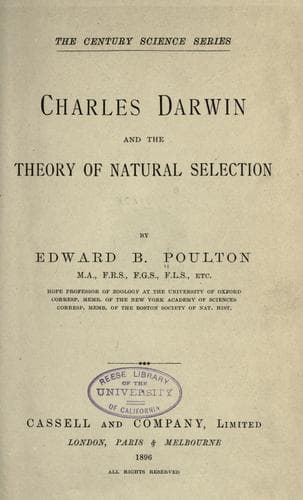
Charles Darwin and the Theory of Natural SelectionPoulton, Edward Bagnall, Sir
Science
Charles Darwin and the Theory of Natural Selection
Poulton, Edward Bagnall, Sir
Darwin, Charles, 1809-1882; Natural selection
The first section of Darwin’s communication consisted of extracts
from the Second Chapter of the First Part of his manuscript essay of
1844. The Part was entitled “The Variation of Organic Beings under
Domestication, and in their Natural State,” and the Second Chapter was
headed “On the Variation of Organic Beings in a State of Nature; on
the Natural Means of Selection; on the Comparison of Domestic Races
and True Species.” The extracts first deal with the tendency towards
rapid multiplication and the consequent struggle for life. The average
constancy of the numbers of individuals is traced to the average
constancy of the amount of food, “whereas the increase of all organisms
tends to be geometrical.” Practical illustrations are given in the
enormous increase of the mice in La Plata during the drought which
killed millions of cattle, and in the well-known and rapid increase
of the animals and plants introduced by man into a new and favourable
country.
The checks which operate when the country is stocked and the species
reaches its average are most difficult to detect, but none the less
certain. If any check is lightened in the case of any organism it will
at once tend to increase. “Nature may be compared to a surface on which
rest ten thousand sharp wedges touching each other and driven inward by
incessant blows.” Darwin meant by this image to express that just as
any single wedge would instantly rise above the rest when the blows on
it were in any way lessened as compared with those on the other wedges,
so it would be with the proportionate number of any species when the
checks to which it is subjected are in any way relaxed.
If the external conditions alter, and the changes continue progressing,
the inhabitants will be less well adapted than formerly. The changed
conditions would act on the reproductive system and render the
organisation plastic. Now, can it be doubted, from the struggle each
individual has to obtain subsistence, that any minute variation in
structure, habits, or instincts adapting that individual better to the
new conditions would tell upon its vigour and health? “Yearly more are
bred than can survive; the smallest grain in the balance, in the long
run, must tell on which death shall fall, and which shall survive.” If
this went on for a thousand generations who will deny its effect “when
we remember what, in a few years, Bakewell effected in cattle, and
Western in sheep, by this identical principle of selection?”
Public-domain text, read in full here on John Shaqi.
Reviews
Reviews
No reviews yet
Be the first to share your thoughts on this work.
Join the Discussion
Join the discussion
Sign in to leave a comment or review.
Sign InorCreate an account