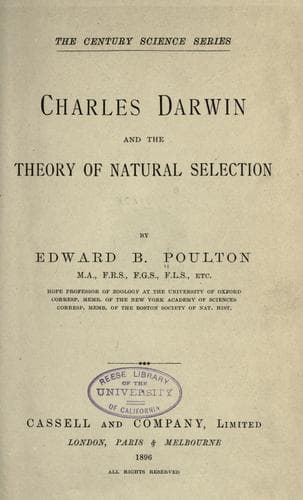
Charles Darwin and the Theory of Natural SelectionPoulton, Edward Bagnall, Sir
Science
Charles Darwin and the Theory of Natural Selection
Poulton, Edward Bagnall, Sir
Darwin, Charles, 1809-1882; Natural selection
Lamarck’s hypothesis of change produced by the attempts of animals to
increase the development of their own organs has been often refuted,
but the view here proposed depends upon the action of principles
constantly working in nature. Retractile talons of falcons and cats
have not been developed by volition, but by _the survival of those
which had the greatest facilities for seizing prey_. The long neck of
the giraffe was not produced by constant stretching, but by the success
which any increase in the length of neck ensured to its possessors.
Even colours, especially of insects, are explained in the same way,
for among the varieties of many tints, those “having colours best
adapted to concealment ... would inevitably survive the longest.” We
can similarly explain deficiency of some organs with compensating
development of others, “great velocity making up for the absence of
defensive weapons,” etc. Varieties with an unbalanced deficiency could
not long survive. The action of the principle is like the governor
of a steam-engine, checking irregularities almost before they become
evident. Such a view accords well with “the many lines of divergence
from a central type”; the increasing efficiency of a particular organ
in a series of allied species; the persistence of unimportant parts
when important ones have changed; the “more specialised structure,”
said by Owen to be characteristic of recent as compared with extinct
forms.
Hence there is a tendency of certain classes of _varieties_ to progress
further and further from the original type, and there is no reason for
assigning any limit to this progression. Such gradual changes “may,
it is believed, be followed out so as to agree with all the phenomena
presented by organised beings, their extinction and succession in past
ages, and all the extraordinary modifications of form, instinct, and
habits which they exhibit.”
Wallace’s Essay has been reprinted without any alteration in his
“Essays on Natural Selection,” recently re-issued combined with
“Tropical Nature.”
CHAPTER XI.
COMPARISON OF DARWIN’S AND WALLACE’S SECTIONS OF THE JOINT
MEMOIR--RECEPTION OF THEIR VIEWS--THEIR FRIENDSHIP.
[Sidenote: WALLACE AND DARWIN.]
Comparing the essays of these two naturalists, we observe that Darwin
here first makes public the phrase “natural selection,” Wallace the
“struggle for existence”; although so closely do their lines of thought
converge that Darwin, using practically the same words, speaks of
the “struggle for life.” Both show, by examples, the tendency of all
animals to multiply at an enormous rate, and both show that their
tolerably constant numbers are due to the constant supply of food.
Public-domain text, read in full here on John Shaqi.
Reviews
Reviews
No reviews yet
Be the first to share your thoughts on this work.
Join the Discussion
Join the discussion
Sign in to leave a comment or review.
Sign InorCreate an account