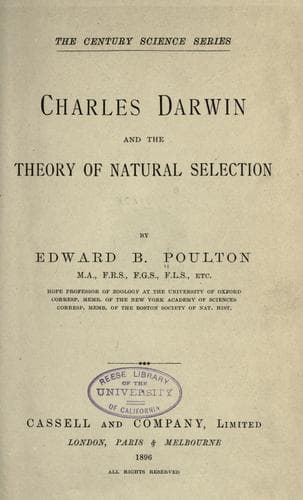
Charles Darwin and the Theory of Natural SelectionPoulton, Edward Bagnall, Sir
Science
Charles Darwin and the Theory of Natural Selection
Poulton, Edward Bagnall, Sir
Darwin, Charles, 1809-1882; Natural selection
Canon Tristram then points out the manner in which he imagines that one
of the crested larks of the desert has been produced by the survival
of the lightest coloured individuals, _Galerida abyssinica_ only
differing in this respect from _G. cristata_ of Europe. Short-billed
species of the same genus inhabiting hard rocky districts, and
long-billed inhabiting loose sandy tracts have, he believes, been
produced by the survival in each case of the forms of bill most suited
to procure food:
“Here are only two causes enumerated which might serve to
_create_ as it were a new species from an old one, yet they
are perfectly natural causes, and such as, I think, must have
occurred, and are possibly occurring still. We know so very
little of the causes which in the majority of cases make
species rare or common, that there may be hundreds of others
at work, some even more powerful than these, which go to
perpetuate and eliminate certain forms ‘according to natural
means of selection.’ But even these superficial causes appear
sufficient to explain the marked features of the Desert races,
which frequently approach so very closely the typical form, and
yet possess such invariably distinctive characteristics, that
naturalists seem agreed to elevate them to the rank of species.”
Although the author also declares his belief in the special creation
of many species--a view put forward as possible by Darwin in the
“Origin”[G]--and also believed in some direct influence of locality,
climate, etc., the above quoted passages are a most complete acceptance
of natural selection, at the same time affording excellent examples of
its operation.
CHAPTER XIV.
THE PREPARATION OF “THE ORIGIN OF SPECIES” (1858–59).
Almost immediately after the Linnean Society meeting, and evidently
earlier than September, the time mentioned in his “Autobiography,”
Darwin began to prepare a longer and more complete account of his work
on evolution and natural selection. This account was at first intended
for the Linnean Society, but it was soon found to be too long, and he
then decided to publish it as an independent volume. In thus preparing
the manuscript for what afterwards became the “Origin of Species,”
Darwin tells us (“Autobiography”) he acted under “the strong advice of
Lyell and Hooker,” and his letters also show the great interest that
they were taking in the work.
Darwin seems to have found the “Origin”--or his “Abstract,” as he
always calls it--very hard work, and he ends his letter to Wallace
(January 25th, 1859) with the words:
“I look at my own career as nearly run out. If I can publish my
Abstract and perhaps my greater work on the same subject, I shall
look at my course as done.”
Public-domain text, read in full here on John Shaqi.
Reviews
Reviews
No reviews yet
Be the first to share your thoughts on this work.
Join the Discussion
Join the discussion
Sign in to leave a comment or review.
Sign InorCreate an account