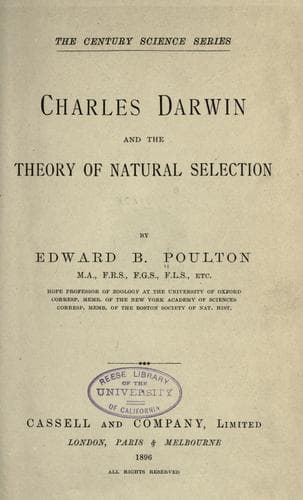
Charles Darwin and the Theory of Natural SelectionPoulton, Edward Bagnall, Sir
Science
Charles Darwin and the Theory of Natural Selection
Poulton, Edward Bagnall, Sir
Darwin, Charles, 1809-1882; Natural selection
At the same time, so great was his enthusiasm and interest, in spite
of the hard work and ill-health, that all through this period he was
making fresh observations whenever an opportunity occurred. Thus we
find him writing to Hooker about the thistle-down blown out to sea and
then back to shore again; about the migrations of slave-making ants
which he had been watching; about the bending of the pistil into the
line of the gangway leading to the honey when this latter “is secreted
at one point of the circle of the corolla,” etc. And on March 2nd,
1859, he writes about “an odd, though very little, fact”:--Large nuts
had been found in the crops of some nestling Petrels at St. Kilda,
which he suspected the parent birds had picked up from the Gulf Stream.
He arranged for one of these to be sent, and asked Hooker for the name
and country. He asks forgiveness for the trouble, “for it is a funny
little fact after my own heart.” The nuts turned out to be West Indian.
When the proposal for publication had been accepted by Murray and the
manuscript was assuming its final form, the letters to Hooker were more
frequent than ever. Writing on May 11th, 1859, Darwin again raises the
question of the relative importance of variation and selection.
“I imagine from some expressions ... that you look at variability
as some necessary contingency with organisms, and further that
there is some necessary tendency in the variability to go on
diverging in character or degree. _If you do_, I do not agree.”
Darwin’s splendid confidence in the future appears in a letter written
about this time (September 2, 1859) in which he begs Lyell not to
commit himself “to go a certain length and no further; for,” he says,
“I am deeply convinced that it is absolutely necessary to go the whole
vast length, or stick to the creation of each separate species.” He
asks Lyell to remember that his verdict will probably be of more
importance than the book itself in influencing the present acceptance
or rejection of the views. “In the future,” he continues, “I cannot
doubt about their admittance, and our posterity will marvel as much
about the current belief as we do about fossil shells having been
thought to have been created as we now see them.” And again writing
to Lyell a few days later (September 20th), he says, “I cannot too
strongly express my conviction of the general truth of my doctrines,
and God knows I have never shirked a difficulty.”
I have thought it well to bring strong evidence of Darwin’s entire
confidence in his conclusions, because his writings were so
extraordinarily balanced and judicial, and the weight he gives to
opposing considerations so great, that a superficial student might
imagine that he wrote and argued without any very strong convictions.
Public-domain text, read in full here on John Shaqi.
Reviews
Reviews
No reviews yet
Be the first to share your thoughts on this work.
Join the Discussion
Join the discussion
Sign in to leave a comment or review.
Sign InorCreate an account