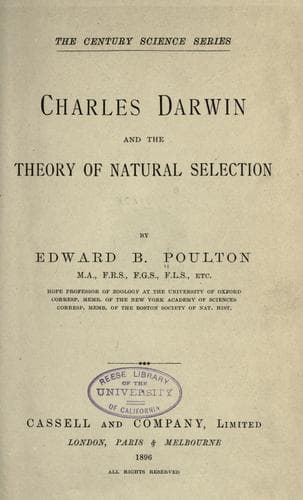
Charles Darwin and the Theory of Natural SelectionPoulton, Edward Bagnall, Sir
Science
Charles Darwin and the Theory of Natural Selection
Poulton, Edward Bagnall, Sir
Darwin, Charles, 1809-1882; Natural selection
The first part of the title of the first edition--“On the Origin of
Species”--becomes “The Origin of Species” in the last edition, and is
still further shortened to “Origin of Species” on the outside of the
volume.
The form of the earlier editions was admirably suited for the purpose
of attracting, and--so far as was possible with so difficult a
subject--convincing, a large number of readers. When the subject
was new and strange, the more numerous details of the last edition,
and the smaller print which became necessary, would have acted as a
hindrance to the complete success of the work. Authors and publishers
are sometimes apt to forget that the form of a book has a great deal to
do with the absorption of the ideas contained in it, especially when
the argument is from the nature of the case difficult to follow, and
the subject a new one. Francis Darwin in the “Life and Letters” justly
condemns the unattractive form of the sixth edition of the work.
CHAPTER XVI.
THE INFLUENCE OF DARWIN UPON LYELL (1859–64).
In considering the reception of the “Origin of Species,” it will
be well first to show its effect upon Darwin’s intimate scientific
friends, most of whom had been familiar with his work for many years,
and then to deal with its effects upon biologists generally, especially
those of Darwin’s own country.
The gradual strengthening of Darwin’s influence over his old teacher
Lyell, is one of the most interesting episodes in the personal history
of the scientific men of this century.
[Sidenote: LYELL’S SLOW CONVERSION.]
Lyell, after reading the proof-sheets of the “Origin,” wrote on
October 3rd, 1859, praising the work very warmly, and suggesting a few
improvements, some of which were adopted. Lyell hesitated to accept
the theory, because he saw clearly that it would be impossible to stop
short at the human species, while a common origin of men and beasts was
distasteful to him. Thus, he said:--
“I have long seen most clearly that if any concession is made,
all that you claim in your concluding pages will follow. It is
this which has made me so long hesitate, always feeling that
the case of man and his races, and of other animals, and that
of plants is one and the same, and that if a ‘vera causa’ be
admitted for one, instead of a purely unknown and imaginary one,
such as the word ‘Creation,’ all the consequences must follow.”
To this letter Darwin replied (October 11th) at great length, in a most
instructive letter, arguing in considerable detail on all the points
alluded to by Lyell. He evidently thought that Lyell’s opinion was of
the utmost importance for the success of Natural Selection. “If ever
you are [perverted],” he wrote at the end of the letter, “I shall know
that the theory of Natural Selection is, in the main, safe.”
Public-domain text, read in full here on John Shaqi.
Reviews
Reviews
No reviews yet
Be the first to share your thoughts on this work.
Elsewhere in the archive
Join the Discussion
Join the discussion
Sign in to leave a comment or review.
Sign InorCreate an account