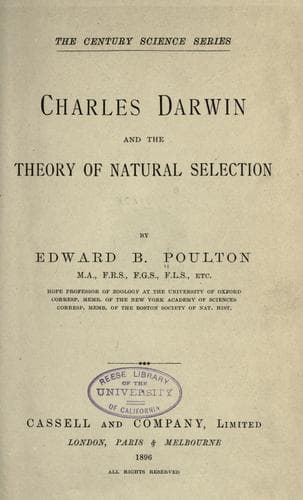
Charles Darwin and the Theory of Natural SelectionPoulton, Edward Bagnall, Sir
Science
Charles Darwin and the Theory of Natural Selection
Poulton, Edward Bagnall, Sir
Darwin, Charles, 1809-1882; Natural selection
About this time Darwin seems to have heard that Lyell had made up his
mind to admit the doctrine of evolution into a new edition of the
“Manual,” and he wrote (November 23rd):--
“I honour you most sincerely. To have maintained in the position
of a master, one side of a question for thirty years, and then
deliberately give it up, is a fact to which I much doubt whether
the records of science offer a parallel.”
Lyell’s public confession of faith was, however, not to be made for
some years, and Darwin’s letter was a little premature.
Space will not permit me to quote from the long correspondence
with Lyell in the years following the appearance of the “Origin,”
although these letters are of the deepest interest, and deal in the
most luminous manner with the difficulties of natural selection and
evolution, as they appeared to one of the acutest intellects of that
time. The letters soon began to produce an effect, and Darwin wrote
(September 26th, 1860) to Asa Gray:--
“I can perceive in my immense correspondence with Lyell, who
objected to much at first, that he has, perhaps unconsciously to
himself, converted himself very much during the last six months,
and I think this is the case even with Hooker. This fact gives me
far more confidence than any other fact.”
Later on Darwin evidently became a little annoyed that Lyell still
delayed to declare his belief one way or the other. Thus he wrote to
Asa Gray (May 11th, 1863):--
“You speak of Lyell as a judge; now what I complain of is that
he declines to be a judge.... I have sometimes almost wished
that Lyell had pronounced against me. When I say ‘me,’ I only
mean _change of species by descent_. That seems to me the
turning-point. Personally, of course, I care much about Natural
Selection; but that seems to me utterly unimportant, compared to
the question of Creation _or_ Modification.”
Shortly before this date, on February 24th, he wrote to Hooker in
much the same style. These communications were called forth by the
appearance of “The Antiquity of Man,” and it is clear that Darwin’s
disappointment at Lyell’s suspended judgment was due to their
correspondence, which had encouraged him to expect some definite
opinion on the question. “From all my communications with him, I must
ever think that he has really entirely lost faith in the immortality
of species,” he wrote in his letter to Hooker. On March 6th he wrote
to Lyell himself, expressing his disappointment, and again a few days
later, rather complaining that his work was treated as a modification
of Lamarck’s:--
“This way of putting the case ... closely connects Wallace’s and
my views with what I consider, after two deliberate readings, as
a wretched book, and one from which (I well remember my surprise)
I gained nothing.”
Public-domain text, read in full here on John Shaqi.
Reviews
Reviews
No reviews yet
Be the first to share your thoughts on this work.
Elsewhere in the archive
Join the Discussion
Join the discussion
Sign in to leave a comment or review.
Sign InorCreate an account