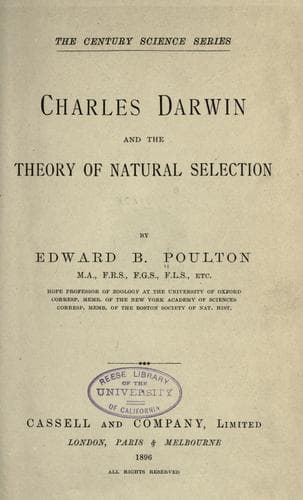
Charles Darwin and the Theory of Natural SelectionPoulton, Edward Bagnall, Sir
Science
Charles Darwin and the Theory of Natural Selection
Poulton, Edward Bagnall, Sir
Darwin, Charles, 1809-1882; Natural selection
When the second edition of “The Antiquity of Man” appeared in a few
months, there was a significant change in one sentence:--
“Yet we ought by no means to undervalue the importance of the
step which will have been made, should it hereafter become
the generally received opinion of men of science (as I fully
expect it will) that the past changes of the organic world have
been brought about by the subordinate agency of such causes as
Variation and Natural Selection.”
The words in parentheses had been added, and constituted Lyell’s first
public expression of an opinion in favour of Darwin’s views.
About this time an article appeared in the _Athenæum_ (March 28th,
1863), attacking the opinions in favour of evolution contained in
Dr. Carpenter’s work on Foraminifera, and supporting spontaneous
generation. This was one of the rare occasions on which Darwin entered
into controversy, and he wrote attacking spontaneous generation, and
pointing out the numerous classes of facts which are connected by
an intelligible thread of reasoning by means of his theory. In this
letter he quoted the altered sentence from the second edition of the
“Antiquity.” Darwin’s letter was answered in an article (May 2nd) in
which it was argued that _any_ theory of descent would connect the
various classes of facts equally well. To this Darwin replied in a
characteristic letter. It was evident that he was most reluctant to
continue the controversy, but thought it fair to admit publicly the
force of his opponent’s arguments.
[Sidenote: ACCESSION OF LYELL.]
In 1864 the Copley Medal of the Royal Society was given to Darwin. At
the anniversary dinner of the Society, after the meeting at which the
medals are presented by the President, Sir Charles Lyell in his speech
made a “confession of faith” as to the “Origin.” Darwin was prevented
by illness from receiving the medal in person and from being present at
the dinner.
The tenth edition of the “Principles” was published in 1867 and 1868,
and in it Lyell clearly stated his belief in evolution. Sir Joseph
Hooker, in his presidential address to the British Association at
Norwich in 1868, eloquently spoke of the “new foundation” with which
Lyell had under-pinned the edifice he had raised, and had thus rendered
it “not only more secure, but more harmonious in its proportion than
it was before.” Wallace, too, in an article in the _Quarterly Review_
(April, 1869), spoke with equal eloquence and force of the significance
of Lyell’s change of opinion.
Public-domain text, read in full here on John Shaqi.
Reviews
Reviews
No reviews yet
Be the first to share your thoughts on this work.
Elsewhere in the archive
Join the Discussion
Join the discussion
Sign in to leave a comment or review.
Sign InorCreate an account