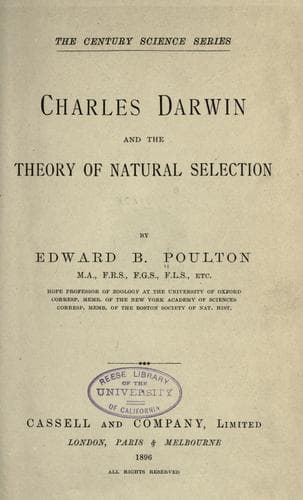
Charles Darwin and the Theory of Natural SelectionPoulton, Edward Bagnall, Sir
Science
Charles Darwin and the Theory of Natural Selection
Poulton, Edward Bagnall, Sir
Darwin, Charles, 1809-1882; Natural selection
Lyell’s death took place in 1875, eleven years after his definite
acceptance of Darwin’s views. Darwin, in writing to Miss Arabella
Buckley (now Mrs. Fisher, formerly secretary to Sir Charles Lyell),
fully acknowledged the deep debt which he owed to Lyell’s teachings:
“I never forget that almost everything which I have done in science
I owe to the study of his great works.” Huxley says in his obituary
of Charles Darwin (reprinted in “Darwiniana,” 1893, p. 268): “It is
hardly too much to say that Darwin’s greatest work is the outcome of
the unflinching application to Biology of the leading idea and the
method applied in the ‘Principles’ to Geology.” Every biologist who
realises--as who can help realising?--the boundless opportunities which
Darwin’s work has opened for him, will feel that he too owes a deep
personal debt to Darwin’s great teacher.
CHAPTER XVII.
INFLUENCE OF DARWIN UPON HOOKER AND ASA GRAY--NATURAL SELECTION AND
DESIGN IN NATURE (1860–68).
Hooker wrote on November 21st, speaking of the “glorious book” in the
warmest terms. Later on in the year he wrote again in the same spirit,
but speaking of the difficulty he found in assimilating the immense
mass of details: “It is the very hardest book to read, to full profits,
that I ever tried--it is so cram-full of matter and reasoning.” Hooker
must, however, have been familiar with the arguments and proofs,
and for this reason did not attempt any detailed discussion. It is
unnecessary to say more of Hooker’s reception of the “Origin.” During
their long friendship Darwin had discussed the difficulties and the
evidences of his theory more fully with him than with any other man;
and, as “a man sharpeneth the countenance of his friend,” the influence
of Hooker was one of the most potent forces under which Darwin produced
the greatest work of his life.
Many years later, when Hooker was awarded, in 1887, the Copley Medal
of the Royal Society, reviewing his past experiences and work in his
speech at the anniversary dinner, he concluded by telling us that his
long and intimate friendship with Charles Darwin was the great event of
his scientific career.
[Sidenote: ASA GRAY.]
In sending a copy to Asa Gray, he wrote (November 11th):--
“I fully admit that there are very many difficulties not
satisfactorily explained by my theory of descent with
modification, but I cannot possibly believe that a false theory
would explain so many classes of facts as I think it certainly
does explain. On these grounds I drop my anchor, and believe that
the difficulties will slowly disappear.”
Public-domain text, read in full here on John Shaqi.
Reviews
Reviews
No reviews yet
Be the first to share your thoughts on this work.
Elsewhere in the archive
Join the Discussion
Join the discussion
Sign in to leave a comment or review.
Sign InorCreate an account