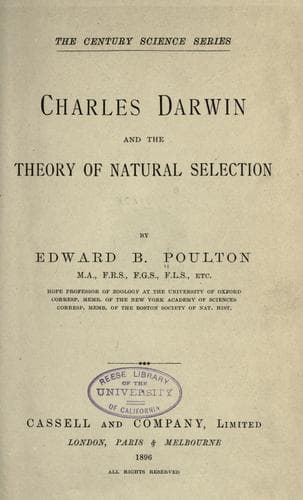
Charles Darwin and the Theory of Natural SelectionPoulton, Edward Bagnall, Sir
Science
Charles Darwin and the Theory of Natural Selection
Poulton, Edward Bagnall, Sir
Darwin, Charles, 1809-1882; Natural selection
Asa Gray’s reply was contained in a letter to Hooker, written January
5th, 1860, four days after reading the “Origin.” He asks that Darwin
may be told of what he had written. He says that the book “is done in
a _masterly manner_. It might well have taken twenty years to produce
it.” He expressed the intention of reviewing the book, and seeing that
Darwin and Hooker had fair play in America. A little later (January
23rd) he wrote to Darwin about the American reprint, etc., and spoke of
the work itself in somewhat greater detail:--
“The _best part_, I think, is the _whole_, _i.e._ its _plan_
and _treatment_, the vast amount of facts and acute inferences
handled as if you had a perfect mastery of them.... Then your
candour is worth everything to your cause. It is refreshing to
find a person with a new theory who frankly confesses that he
finds difficulties.... The moment I understood your premisses,
I felt sure you had a real foundation to hold on.... I am free
to say that I never learnt so much from one book as I have from
yours.”
He considered that the attempt to account for the formation of organs
such as eyes by natural selection, was the weakest point in the book.
This view is to be explained by his strong teleological convictions.
Although Asa Gray was the great exponent of the “Origin” in America,
he could not agree with Darwin on one important point--viz. on the
exclusion of the ordinary conceptions of design in nature by the
principle of natural selection. He believed that the two conceptions
could be reconciled, and that design in some way worked in and through
natural selection. By design is here meant what Huxley called “the
commoner and coarser form of teleology,” and which he believed to be
now refuted--“the teleology which supposes that the eye, such as we see
it in man or one of the higher vertebrata, was made with the precise
structure it exhibits for the purpose of enabling the animal which
possesses it to see, has undoubtedly received its death-blow.” Huxley
goes on to point out that there is a “wider teleology, which ... is
actually based upon the fundamental proposition of evolution ... that
the whole world ... is the result of the mutual interaction, according
to definite laws, of the forces possessed by the molecules of which
the primitive nebulosity of the universe was composed.” Therefore,
“a sufficient intelligence could, from a knowledge of the properties
of the molecules of that vapour, have predicted, say, the state of
the fauna of Britain in 1869, with as much certainty as one can say
what will happen to the vapour of the breath on a cold winter’s day.”
(“Genealogy of Animals,” _The Academy_, 1869, reprinted in “Critiques
and Addresses,” and quoted in his chapter “On the Reception of the
‘Origin of Species’” in the “Life and Letters,” Vol. II.)
Public-domain text, read in full here on John Shaqi.
Reviews
Reviews
No reviews yet
Be the first to share your thoughts on this work.
Elsewhere in the archive
Join the Discussion
Join the discussion
Sign in to leave a comment or review.
Sign InorCreate an account