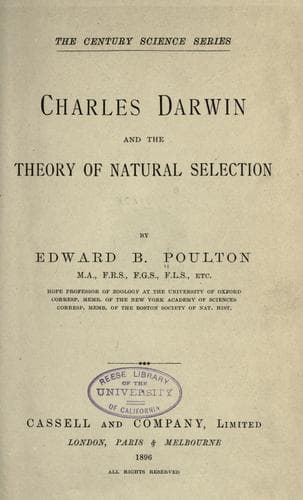
Charles Darwin and the Theory of Natural SelectionPoulton, Edward Bagnall, Sir
Science
Charles Darwin and the Theory of Natural Selection
Poulton, Edward Bagnall, Sir
Darwin, Charles, 1809-1882; Natural selection
But at the time of the appearance of the “Origin,” many who sympathised
with the general drift of the argument were not yet prepared for
the “wider teleology.” Of these Asa Gray may be taken as the
representative; and it will be of interest to follow the controversy
between him and Darwin as regards design and natural selection. The
recently published “Letters of Asa Gray to Charles Darwin” (Macmillan)
enable us to follow the correspondence from the side of the great
American evolutionist.
Writing November 26th, 1860, Darwin refers to one of Asa Gray’s
articles on the “Origin”:--
“I grieve to say that I cannot honestly go as far as you do
about Design. I am conscious that I am in an utterly hopeless
muddle. I cannot think that the world, as we see it, is the
result of chance; and yet I cannot look at each separate thing
as the result of Design. To take a crucial example, you lead me
to infer--that you believe ‘that variation has been led along
certain beneficial lines.’ I cannot believe this; and I think
you would have to believe, that the tail of the Fantail was led
to vary in the number and direction of its feathers in order to
gratify the caprice of a few men. Yet if the Fantail had been a
wild bird, and had used its abnormal tail for some special end,
as to sail before the wind, unlike other birds, everyone would
have said, ‘What a beautiful and designed adaptation.’ Again, I
say I am, and shall ever remain, in a hopeless muddle.”
Elsewhere Darwin suggested that the pouter pigeon, if it occurred
wild, and used its inflated crop as a float, would be considered as a
striking example of design.
This controversy between them continued for many years. We find Asa
Gray referring to the argument of the pigeons three years later. Thus
he wrote (September 1st, 1863):--
“I will consider about fantastic variation of pigeons. I see afar
trouble enough ahead quoad design in nature, but have managed to
keep off the chilliness by giving the knotty questions a rather
wide berth. If I rather avoid, I cannot ignore the difficulties
ahead. But if I adopt your view boldly, can you promise me any
less difficulties?”
Writing the concluding paragraphs of the “Variations of Animals
and Plants under Domestication,” Darwin evidently bore in mind his
controversies on the subject with Asa Gray and Lyell, and the attacks
of the Duke of Argyll and others. Sending advanced sheets to Asa Gray,
he wrote on October 16th, 1867:--
“I finish my book with a semi-theological paragraph, in which I
quote and differ from you; what you will think of it, I know not.”
In relation to this interesting controversy, I think it well to quote,
almost in full, the metaphor by which Darwin enforced his argument that
the origin of species by natural selection precluded a belief in design
in nature as it was ordinarily conceived at the time.
Public-domain text, read in full here on John Shaqi.
Reviews
Reviews
No reviews yet
Be the first to share your thoughts on this work.
Elsewhere in the archive
Join the Discussion
Join the discussion
Sign in to leave a comment or review.
Sign InorCreate an account