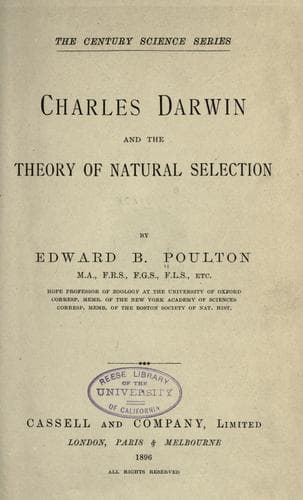
Charles Darwin and the Theory of Natural SelectionPoulton, Edward Bagnall, Sir
Science
Charles Darwin and the Theory of Natural Selection
Poulton, Edward Bagnall, Sir
Darwin, Charles, 1809-1882; Natural selection
At first sight it seems a simple matter to describe the effect of the
“Origin” upon Huxley, considering that he, more than any other man,
expounded it, and defended it from the most weighty of the attacks made
upon it. Hence, it is only natural to believe, as many have done, that
he was in entire agreement with the conclusions of the book as regards
natural selection as well as evolution. On the other hand, the opinion
has often been expressed that Huxley, although agreeing with the
“Origin” for some years after its first appearance, changed his mind in
later years, and no longer supported Darwin’s views.
I shall give reasons for rejecting both these opinions about Huxley,
although the first is far nearer the truth than the second. The
latter is clearly untenable, and was probably merely an inference
from the fact that after a time Huxley ceased to enter into Darwinian
controversies. But this was because he had done his work with entire
success, and therefore turned his attention in other directions.
Whenever he was called on to write or speak about Darwinism, as he was
on two occasions within a few months of his death, his writings and
speeches left no doubt about his thoughts on the subject. Furthermore,
in the Preface to “Darwiniana,” written in 1893, he expressly denied
that he had recanted or changed his opinions about Darwin’s views.
In order to appreciate the influence of Darwin upon Huxley, we must
find out the beliefs of the latter upon the “species question” before
the appearance of the “Origin.” In his chapter “On the Reception of
the ‘Origin of Species’” (“Life and Letters,” Vol. II.) Huxley says
that, before 1858, he took up an agnostic position as regards evolution
“... upon two grounds: firstly, that up to that time, the evidence in
favour of transmutation was wholly insufficient; and, secondly, that no
suggestion respecting the causes of the transmutation assumed, which
had been made, was in any way adequate to explain the phenomena.” It
is obvious that these two grounds are entirely distinct, and that the
logical foundation of the first is far more secure than that of the
second.
Public-domain text, read in full here on John Shaqi.
Reviews
Reviews
No reviews yet
Be the first to share your thoughts on this work.
Elsewhere in the archive
Join the Discussion
Join the discussion
Sign in to leave a comment or review.
Sign InorCreate an account