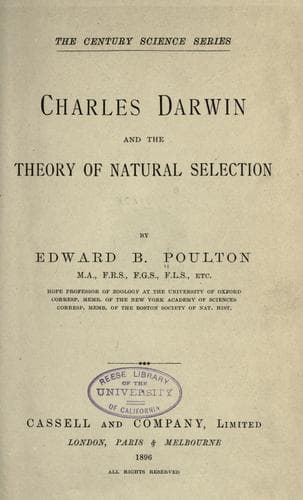
Charles Darwin and the Theory of Natural SelectionPoulton, Edward Bagnall, Sir
Science
Charles Darwin and the Theory of Natural Selection
Poulton, Edward Bagnall, Sir
Darwin, Charles, 1809-1882; Natural selection
The effect of the “Origin” was completely to convince Huxley on the
first ground: from that time he never doubted the truth of evolution,
however it may have been brought about. With regard to the second
ground, it is quite clear that Huxley had a very high opinion of
natural selection: he thought it incomparably the best suggestion upon
the subject that had ever been made, and he firmly believed that it
accounted for something--that it may even have taken a dominant part
in bringing about evolution. On the other hand, he never felt quite
confident about the entire sufficiency of the evidence in its favour.
It is probable that he was far more interested in the establishment
of evolution as a fact than in natural selection as an explanation of
it. He saw the vast amount of research in all kinds of new or almost
neglected lines, which would be directly inspired by evolution. And his
own investigations in some of these lines soon afforded some of the
most weighty evidence in favour of the doctrine. Natural selection had
not the same personal interest for him; no one has expounded it better
or defended it more vigorously and successfully, but Huxley’s own
researches never lay in directions which would have made them available
as a test of the theory. Of natural selection he might have used the
words of Mercutio--it may not be “so deep as a well, nor so wide as a
church door,” to contain the whole explanation of evolution, “but ’tis
enough ’twill serve”; it will, at any rate, prevent him from feeling
the second ground on which he had maintained an agnostic position.
I believe that he maintained these views with inflexible consistency
throughout his life, the only indications of change being in the last
year, when the contrast between his certainty of evolution and his
uncertainty of natural selection, as expressed in the two speeches
quoted on pp. 140, 141, was, perhaps, more sharply marked than at any
other period.
It is now proposed to support this conclusion by many extracts from
Huxley’s writings, as well as from his speeches, which have been
alluded to above. The deep interest of the subject, and the wide
differences of opinion with regard to it, justify, and indeed demand,
copious quotations selected from works and speeches, written and spoken
at many different times during the years between 1858 and 1894.
It may not be out of place to emphasise the fact that the sole
responsibility for the conclusions here drawn rests with the author of
this volume, and that the evidence on which the conclusions rest is
supplied in full.
Public-domain text, read in full here on John Shaqi.
Reviews
Reviews
No reviews yet
Be the first to share your thoughts on this work.
Elsewhere in the archive
Join the Discussion
Join the discussion
Sign in to leave a comment or review.
Sign InorCreate an account