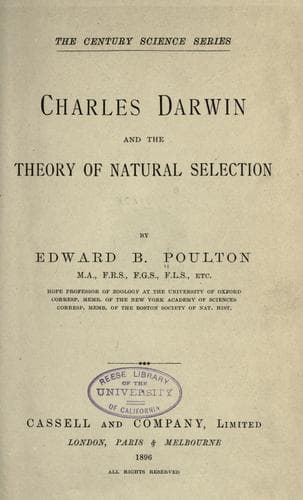
Charles Darwin and the Theory of Natural SelectionPoulton, Edward Bagnall, Sir
Science
Charles Darwin and the Theory of Natural Selection
Poulton, Edward Bagnall, Sir
Darwin, Charles, 1809-1882; Natural selection
“... I am as much convinced now as I was 34 years ago that
the theory propounded by Mr. Darwin, I mean that which he
propounded--not that which has been reported to be his by too
many ill-instructed, both friends and foes--has never yet been
shewn to be inconsistent with any positive observations, and if
I may use a phrase which I know has been objected to and which
I use in a totally different sense from that in which it was
first proposed by its first propounder, I do believe that on
all grounds of pure science it ‘holds the field,’ as the only
hypothesis at present before us which has a sound scientific
foundation.... I am sincerely of opinion that the views which
were propounded by Mr. Darwin 34 years ago may be understood
hereafter as constituting an epoch in the intellectual history of
the human race. They will modify the whole system of our thought
and opinion, our most intimate convictions. But I do not know, I
do not think anybody knows, whether the particular views which he
held will be hereafter fortified by the experience of the ages
which come after us; ... whether the particular form in which
he has put them before us (the Darwinian doctrines) may be such
as is finally destined to survive or not is more, I venture to
think, than anybody is capable at this present moment of saying.”
It is unnecessary to say anything about this passage, which fitly sums
up and sets the seal on the long series of quotations I have felt
obliged to make.
It may not be out of place, however, to state in a few words why
many naturalists, including the present writer, are not inclined to
accept the extremely cautious and guarded language of one upon whom,
with regard to so many other subjects, they have ever looked as their
teacher and guide. Concerning the verification of a hypothesis, Huxley
said in his lectures to working men (“Darwiniana,” pages 367, 368)--
“... that the more extensive verifications are,--that the more
frequently experiments have been made, and results of the same
kind arrived at,--that the more varied the conditions under which
the same results are attained, the more certain is the ultimate
conclusion....”
And again--
“In scientific enquiry it becomes a matter of duty to expose a
supposed law to every possible kind of verification, and to take
care, moreover, that this is done intentionally, and not left to
a mere accident....”
Public-domain text, read in full here on John Shaqi.
Reviews
Reviews
No reviews yet
Be the first to share your thoughts on this work.
Elsewhere in the archive
Join the Discussion
Join the discussion
Sign in to leave a comment or review.
Sign InorCreate an account