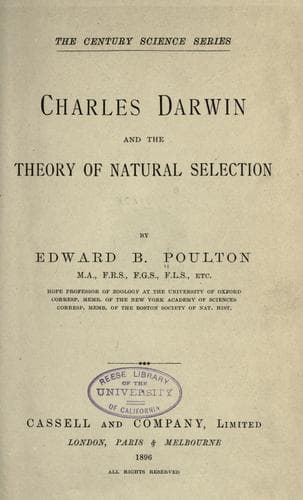
Charles Darwin and the Theory of Natural SelectionPoulton, Edward Bagnall, Sir
Science
Charles Darwin and the Theory of Natural Selection
Poulton, Edward Bagnall, Sir
Darwin, Charles, 1809-1882; Natural selection
It may well be that the length of time required before an
artificially-selected race will exhibit, when interbred with the parent
species, phenomena of hybridism similar to those which are witnessed
when distinct natural species are interbred--will be fatal to the
production of this important line of evidence. But there is nothing to
hinder us from holding the reasonable belief that such evidence might
be obtained if we had command of the necessary conditions; and in the
meantime other evidence of the most satisfactory kind is accumulating,
and on a vast scale. Whenever a naturalist approaches a problem in the
light of the theory of natural selection, and is able, by its aid,
to predict a conclusion which subsequent investigation proves to be
correct, he is helping in the production of evidence in favour of the
theory. When a naturalist has found the formula “if natural selection
be true so-and-so ought to happen” the safest of all guides into
the unknown, when it has brought him success many times and in very
different directions, when he knows that many other workers in other
fields of biological inquiry have had a similarly happy experience, he
gradually comes to feel a profound confidence in the permanent truth
and the far-reaching importance of the great theory which has served
him so well.
CHAPTER XIX.
THE DIFFICULTY WITH WHICH THE “ORIGIN” WAS UNDERSTOOD.
Even earlier than Huxley, H. C. Watson wrote warmly accepting natural
selection. In his letter, which is dated November 21st, 1859, he said:--
“Your leading idea will surely become recognised as an
established truth in science--_i.e._ ‘Natural Selection.’ It has
the characteristics of all great natural truths, clarifying what
was obscure, simplifying what was intricate, adding greatly to
previous knowledge. You are the greatest revolutionist in natural
history of this century, if not of all centuries.”
[Sidenote: MISUNDERSTANDING OF THE THEORY.]
For some years to come, however, such views as these were the
exception, as will soon be shown.
The Duke of Argyll has argued (_Nineteenth Century_, December,
1887) that the success of “Natural Selection” has followed from the
convincing character of the words used, scientific men (“the populace
of science” he calls them) being so easily led by the power of loose
analogies that they have been convinced of the truth of the principle
because they are familiar with Nature on the one hand, and selection as
a process on the other!
Public-domain text, read in full here on John Shaqi.
Reviews
Reviews
No reviews yet
Be the first to share your thoughts on this work.
Elsewhere in the archive
Join the Discussion
Join the discussion
Sign in to leave a comment or review.
Sign InorCreate an account