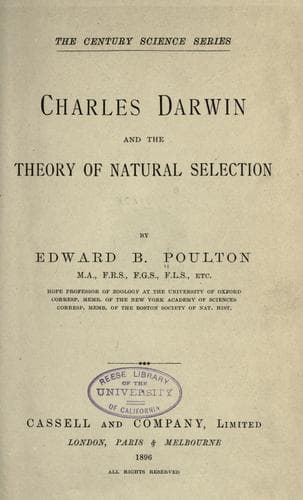
Charles Darwin and the Theory of Natural SelectionPoulton, Edward Bagnall, Sir
Science
Charles Darwin and the Theory of Natural Selection
Poulton, Edward Bagnall, Sir
Darwin, Charles, 1809-1882; Natural selection
“The ever-memorable meeting ... at Oxford in the summer of 1860
saw the first open conflict between the professors of the new
faith and the adherents of the old one. Far be it from me to
blame those among the latter who honestly stuck to the creed in
which they had educated themselves; but my admiration is for the
few dauntless men who, without flinching from the unpopularity
of their cause, flung themselves in the way of obloquy, and
impetuously assaulted the ancient citadel in which the sanctity
of ‘species’ was enshrined and worshipped as a palladium. However
strongly I myself sympathised with them, I cannot fairly state
that the conflict on this occasion was otherwise than a drawn
battle; and thus matters stood when in the following year the
Association met in this city [Manchester]. That, as I have
already said, was a time of ‘slack water.’ But though the ancient
beliefs were not much troubled, it was for the last time that
they could be said to prevail; and thus I look upon our meeting
in Manchester 1861 as a crisis in the history of biology. All
the same, the ancient beliefs were not allowed to pass wholly
unchallenged; and one thing is especially to be marked--they
were challenged by one who was no naturalist at all, by one who
was a severe thinker no less than an active worker; one who was
generally right in his logic, and never wrong in his instinct;
one who, though a politician, was invariably an honest man--I
mean the late Professor Fawcett. On this occasion he brought the
clearness of his mental vision to bear upon Mr. Darwin’s theory,
with the result that Mr. Darwin’s method of investigation was
shewn to be strictly in accordance with the rules of deductive
philosophy, and to throw light where all was dark before.”
Professor Newton specially alluded to this interesting case of
Professor Fawcett as illustrating his conviction that the theory of
natural selection--
“did not, except in one small point, require a naturalist to
think it out and establish its truth.... But in order to see the
effect of this principle upon organic life the knowledge--the
peculiar knowledge--of the naturalist was required. This was
the knowledge of those slight variations which are found in
all groups of animals and plants.... Herein lay the triumph
of Mr. Darwin and Mr. Wallace. That triumph, however, was not
celebrated at Manchester. The question was of such magnitude as
to need another year’s incubation, and the crucial struggle came
a twelvemonth later when the Association met at Cambridge. The
victory of the new doctrine was then declared in a way that none
could doubt. I have no inclination to join in the pursuit of the
fugitives.”
Public-domain text, read in full here on John Shaqi.
Reviews
Reviews
No reviews yet
Be the first to share your thoughts on this work.
Elsewhere in the archive
Join the Discussion
Join the discussion
Sign in to leave a comment or review.
Sign InorCreate an account