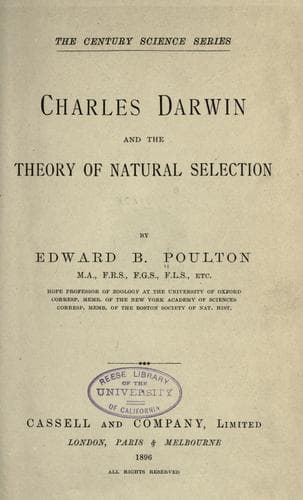
Charles Darwin and the Theory of Natural SelectionPoulton, Edward Bagnall, Sir
Science
Charles Darwin and the Theory of Natural Selection
Poulton, Edward Bagnall, Sir
Darwin, Charles, 1809-1882; Natural selection
There is reason to believe that Professor Newton’s impressions of the
result of the celebrated meeting of the British Association at Oxford
in 1860 are more accurate than those of the eyewitness quoted in the
“Life and Letters.” The latter has pictured a brilliant triumph for
Huxley in the renowned duel with the Bishop of Oxford. But I have
been told by more than one of the audience that Huxley was really too
angry to speak effectively, nor is this to be wondered at, considering
the extreme provocation. Mr. William Sidgwick, who was present and
sympathised warmly with Huxley, has told me that this was his opinion.
I have heard the same from the Rev. W. Tuckwell, who also quoted a
remark of the late Professor Rolleston tending in the same direction.
Mr. Tuckwell said that it was clear that the audience as a whole
was not carried away by Huxley’s speech, but, on the contrary, was
obviously shocked at it; and he contrasted that occasion with another
at which he was also present, in the North, several years later,
when Huxley replied to an opponent who, like the bishop, appealed to
the theological prejudices of his hearers. But by that time the new
teachings had been absorbed, and Huxley gained a signal triumph.
[Sidenote: OPPOSITION.]
It must not be supposed that Darwin was by any means indifferent to the
attacks on his views. On the contrary, his sensitive nature was greatly
depressed by the violent and often most unfair criticisms to which he
was subjected, although beneath this evident disturbance lay the firm
conviction that he had seen the truth, and that the truth would in the
end be seen by others.
After the great fight with the bishop at the British Association at
Oxford, he wrote to Hooker (July 2nd, 1860):--
“I have read lately so many hostile views, that I was beginning
to think that perhaps I was wholly in the wrong, and that ----
was right when he said the whole subject would be forgotten in
ten years; but now that I hear that you and Huxley will fight
publicly (which I am sure I never could do), I fully believe that
our cause will, in the long-run, prevail.”
Looking at the history of opinion on this subject, the slowness with
which the new ideas were absorbed appears remarkable. Even so able a
man as the late Professor Rolleston wrote in 1870 (“Forms of Animal
Life,” Introduction, p. xxv., First Edition) the following carefully
guarded sentences, which, it is to be noted, deal with evolution rather
than natural selection. Speaking of “the theory of evolution with which
Mr. Darwin’s name is connected,” Rolleston says:--
Public-domain text, read in full here on John Shaqi.
Reviews
Reviews
No reviews yet
Be the first to share your thoughts on this work.
Elsewhere in the archive
Join the Discussion
Join the discussion
Sign in to leave a comment or review.
Sign InorCreate an account