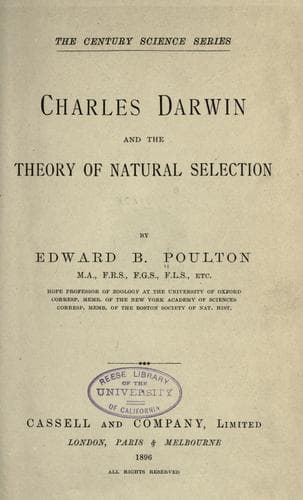
Charles Darwin and the Theory of Natural SelectionPoulton, Edward Bagnall, Sir
Science
Charles Darwin and the Theory of Natural Selection
Poulton, Edward Bagnall, Sir
Darwin, Charles, 1809-1882; Natural selection
“It is often said that all the conditions for the first
production of a living organism are now present, which could
ever have been present. But if (and oh! what a big if!) we could
conceive in some warm little pond, with all sorts of ammonia
and phosphoric salts, light, heat, electricity, etc., present,
that a proteine compound was chemically formed ready to undergo
still more complex changes, at the present day such matter would
be instantly devoured or absorbed, which would not have been the
case before living creatures were formed.”
About 1870 Dr. H. C. Bastian began working on the subject, and brought
forward in his “Origin of Lowest Organisms” (1871), and “The Beginnings
of Life” (1872), what he believed to be conclusive evidence of the
truth of spontaneous generation, for which he proposed the term
Archebiosis. His enthusiasm and strong convictions were contagious, and
for a time the belief spread rather widely, although it soon collapsed
before the researches and arguments of Pasteur, Tyndall, and Huxley.
Darwin read “The Beginnings of Life,” and wrote about it to Wallace
(August 28th, 1872) as follows:--
“His [Bastian’s] general argument in favour of Archebiosis is
wonderfully strong, though I cannot think much of some few of
his arguments. The result is that I am bewildered and astonished
by his statements, but am not convinced, though, on the whole,
it seems to me probable that Archebiosis is true. I am not
convinced, partly I think owing to the deductive cast of much of
his reasoning; and I know not why, but I never feel convinced
by deduction, even in the case of H. Spencer’s writings.... I
must have more evidence that germs, or the minutest fragments of
the lowest forms, are always killed by 212° of Fahr.... As for
Rotifers and Tardigrades being spontaneously generated, my mind
can no more digest such statements, whether true or false, than
my stomach can digest a lump of lead.”
CHAPTER XXI.
VARIATION OF ANIMALS AND PLANTS UNDER DOMESTICATION: PANGENESIS (1868).
We now come to consider the succession of invaluable works produced by
Darwin after the appearance of the “Origin,” the last of which--that on
Earthworms--was published about six months before his death.
Darwin’s method of bringing these results before the world was
somewhat different from that most generally adopted by scientific men
in this country, although of common occurrence in Germany. The great
majority of scientific facts are here published by the proceedings
or transactions of scientific societies, or in special journals; and
although a scientific man frequently brings together his general
results into a volume for the public, the original communications
remain as the detailed exposition of his researches.
Public-domain text, read in full here on John Shaqi.
Reviews
Reviews
No reviews yet
Be the first to share your thoughts on this work.
Elsewhere in the archive
Join the Discussion
Join the discussion
Sign in to leave a comment or review.
Sign InorCreate an account