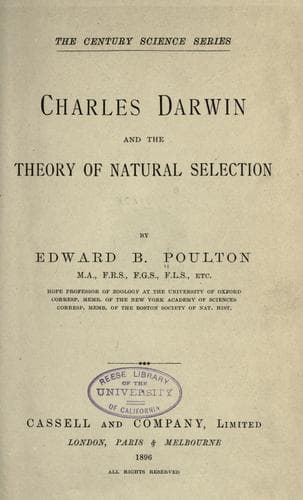
Charles Darwin and the Theory of Natural SelectionPoulton, Edward Bagnall, Sir
Science
Charles Darwin and the Theory of Natural Selection
Poulton, Edward Bagnall, Sir
Darwin, Charles, 1809-1882; Natural selection
“Sprung from a race of theologians, this celebrated man combated
to the last the theory of natural selection. One of the many
times I had the pleasure of meeting him in the United States
was at Mr. Winthrop’s beautiful residence at Brookline, near
Boston. Rising from luncheon, we all halted, as if by a common
impulse in front of a window, and continued there a discussion
which had been started at table. The maple was in its autumn
glory; and the exquisite beauty of the scene outside seemed, in
my case, to interpenetrate without disturbance the intellectual
action. Earnestly, almost sadly, Agassiz turned and said to the
gentlemen standing round, ‘I confess that I was not prepared to
see this theory received as it has been by the best intellects
of our time. Its success is greater than I could have thought
possible.’”[J]
The history of science can hardly supply anything more sad than the
blight which may fall on a man’s career because he is unable, from
conscientious motives, to use some great means of advance. Such a
weapon for the progress of science was provided by the Darwinian
theory, and men were to be henceforth divided according to their use
or neglect of the new opportunities. Men who up to that time had been
equals were to be for ever separated, some to press forward in the
front rank of scientific discovery, others to remain as interesting
relics of a byegone age.
It is hardly necessary to say that this does not apply to men, like
Agassiz, who had already left their mark deep upon the science of their
day, but it has a very real application to those men whose position
was to be estimated by work done after the year 1858.
In the midst of those years of struggle and anxiety which followed the
appearance of the “Origin,” we meet with another instance of the same
extraordinary foresight which appeared in his contention in favour of
the persistence of the great oceans and continental areas. I refer to
his views on spontaneous generation--a very ancient belief, and one
which from time to time has been the will-o’-the-wisp of biological
speculation, leading it into all kinds of fruitless and dangerous
regions.[K]
Dr. Carpenter’s “Introduction to the Study of Foraminifera” had been
reviewed in the _Athenæum_ (March 28th, 1863), the writer attacking
evolution and favouring spontaneous generation, or, as it was then
called, heterogeny. Darwin wrote to Hooker, who had lent him a copy of
the paper, “Who would have ever thought of the old stupid _Athenæum_
taking to Oken-like transcendental philosophy written in Owenian
style!... It will be some time before we see ‘slime, protoplasm, etc.,’
generating a new animal.... It is mere rubbish, thinking at present of
the origin of life; one might as well think of the origin of matter.”
In 1871 he wrote:--
Public-domain text, read in full here on John Shaqi.
Reviews
Reviews
No reviews yet
Be the first to share your thoughts on this work.
Elsewhere in the archive
Join the Discussion
Join the discussion
Sign in to leave a comment or review.
Sign InorCreate an account