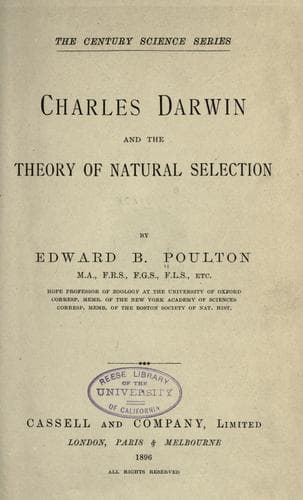
Charles Darwin and the Theory of Natural SelectionPoulton, Edward Bagnall, Sir
Science
Charles Darwin and the Theory of Natural Selection
Poulton, Edward Bagnall, Sir
Darwin, Charles, 1809-1882; Natural selection
This work is considered by some writers to be the greatest produced by
Darwin; but I think we shall be right in accepting his own opinion that
such words should be applied to the “Origin.” It is probable, however,
that this book stands second in importance in the splendid list of
works which have done so much to increase our knowledge of nature and
to inspire others to continue the good work.
[Sidenote: ON VARIATION.]
“The Variation of Animals and Plants under Domestication” opens with
a very clearly written account of natural selection; it proceeds to
treat of the domestic quadrupeds and birds, describing the differences
between the various breeds of each species, and making out as far as
possible the history of their development from each other and from the
wild stock. Cultivated plants are then treated in the same manner.
The first volume concludes with two most important chapters on
bud-variation and anomalous modes of reproduction, and on inheritance.
The second volume deals with inheritance, crossing, effect of
conditions of life, sterility, hybridism, selection by man, causes
and laws of variability. Finally, all the main lines are brought to
a common centre in the wonderful chapter in which he discloses his
“provisional hypothesis of pangenesis.” This is of such interest,
and is so characteristic of its author’s power of viewing the most
divergent facts from a common standpoint, that it is desirable to give
a tolerably full account of it.
The following is a brief statement of the various classes of facts
which Darwin attempted to connect by his hypothesis.
_Reproduction_ is sexual and asexual, and the latter is of various
kinds, although their differences are more apparent than real. It may
be concluded that gemmation or budding, fission or division, the repair
of injuries, the maintenance of each part, and the growth of the embryo
“are all essentially the results of one and the same great power.”
In parthenogenesis the ovum can develop without fertilisation, and
hence the union of germs from different individuals cannot serve as
an essential characteristic of sexual, as compared with asexual,
generation. Although sexually-produced individuals tend to vary far
more than those which are produced asexually, this is not always the
case, and the variability, when it occurs, is subject to the same
laws. Sexually-produced individuals very generally pass in development
from a lower to a higher grade; but this can hardly be said to occur in
certain forms, such as Aphis, etc.
Public-domain text, read in full here on John Shaqi.
Reviews
Reviews
No reviews yet
Be the first to share your thoughts on this work.
Elsewhere in the archive
Join the Discussion
Join the discussion
Sign in to leave a comment or review.
Sign InorCreate an account