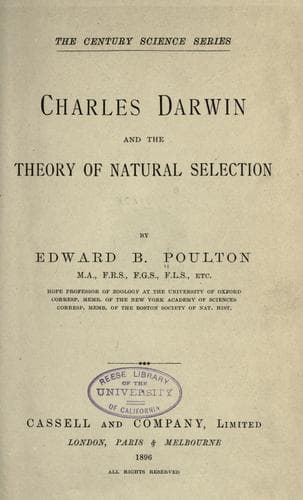
Charles Darwin and the Theory of Natural SelectionPoulton, Edward Bagnall, Sir
Science
Charles Darwin and the Theory of Natural Selection
Poulton, Edward Bagnall, Sir
Darwin, Charles, 1809-1882; Natural selection
The differences between the two forms of reproduction being thus much
less than at first sight appears, we are led to inquire for the reason
why the more complex and difficult process is so universal. Sexual
reproduction appears to confer two benefits on organisms--(1) “When
species are rendered highly variable by changed conditions of life,
the free intercrossing of the varying individuals will tend to keep
each form fitted for its proper place in nature, and crossing can be
effected only by sexual generation”; (2) Many experiments tend to show
that free and wide intercrossing induces vigour in the offspring.
Darwin concludes that the reason why the germ-cell perishes if it does
not unite with another from the opposite sex is simply because it
includes “too little formative matter for independent existence and
development.” He was led to this conclusion by the fact that the male
and female germ-cells “do not in ordinary cases differ in their power
of giving character to the embryo,” and also from experiments which
seemed to show that a certain number of pollen grains or of spermatozoa
may be required to fertilise a single seed or ovum. “The belief that
it is the function of the spermatozoa to communicate life to the ovule
seems a strange one, seeing that the unimpregnated ovule is already
alive, and continues for a considerable time alive.”
It is very remarkable to note how largely Professor Weismann’s
conclusions on this subject were anticipated by this part of Darwin’s
work.
_Graft hybrids._--The probability that a graft may alter the character
of the stock to which it is united, so that hybrid buds might be formed
by budding or grafting the tissues of distinct varieties or species,
would, if it became a certainty, prove the essential identity of
sexual and asexual reproduction; “for the power of combining in the
offspring the characters of both parents is the most striking of all
the functions of sexual generation.”
_Direct action of the male element on the female._--Pollen from another
species is known to affect the mother-plant in certain cases. Thus
pollen from the lemon has caused stripes of lemon-peel in the fruit of
the orange; the peel is, of course, formed by the mother-plant, and
is quite different from the part which the male element is adapted to
affect--viz. the ovule. Similar cases are known among animals, as in
the celebrated example of Lord Morton’s mare.
_Development._--The changes by which the embryo reaches maturity
differ immensely, even within the limits of the same compact group.
Forms which closely resemble each other in the mature state, and
are intimately related to each other, such as the various species
of lobster and crayfish, etc., pass through a totally different
developmental history. Hence we are led to believe in the complete
independence of “each structure from that which precedes and follows it
in the course of development.”
Public-domain text, read in full here on John Shaqi.
Reviews
Reviews
No reviews yet
Be the first to share your thoughts on this work.
Elsewhere in the archive
Join the Discussion
Join the discussion
Sign in to leave a comment or review.
Sign InorCreate an account