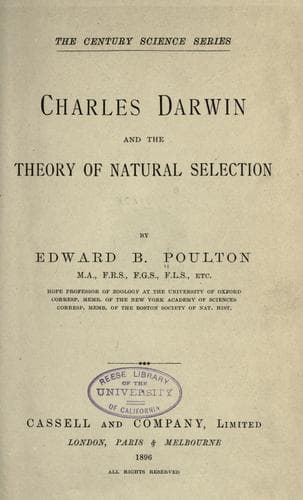
Charles Darwin and the Theory of Natural SelectionPoulton, Edward Bagnall, Sir
Science
Charles Darwin and the Theory of Natural Selection
Poulton, Edward Bagnall, Sir
Darwin, Charles, 1809-1882; Natural selection
_Transposition and multiplication of parts._--The cases of abnormal
transposition or multiplication of organs--for instance, the
development of teeth in the palate or of pollen in the edge of a
petal--are to be explained by supposing that the gemmules unite with
wrong cells instead of, or as well as, the right ones; “and this would
follow from a slight change in their elective affinities.” Such slight
changes are known to occur; for instance, certain plants “absolutely
refuse to be fertilised by their own pollen, though abundantly fertile
with that of any other individual of the same species.” Inasmuch as the
cells of adjoining parts will often have nearly the same structure, we
can understand that some slight change in elective affinity may affect
a large area. Hence we can account for a crowd of horns on the head of
a sheep, or many spurs on the leg of a fowl, etc. Frequently repeated
parts are extremely liable to vary in number; in this case we have a
large number of closely allied gemmules and of points for their union,
and slight changes in elective affinity would be specially apt to
occur.
VARIABILITY.--Changed conditions may lead to irregularity in the number
of gemmules derived from various parts of the body; deficiency in
number might cause variation in any part by leaving some of the cells
free to unite with allied gemmules.
The direct action of surroundings, or the effect of use or disuse
on a part, may cause corresponding modifications of the gemmules,
and through these of the part in the succeeding generation. “A more
perplexing problem can hardly be proposed,” and yet it receives an
explanation on this hypothesis. Such causes must, as a rule, act during
many generations before the modification reappears in the offspring.
This may be due to the unaltered gemmules derived from earlier
generations, and their gradual replacement by the increasing number of
altered gemmules.
Variation in plants is much more frequent in sexually produced than it
is in asexually produced individuals. This may be due to the absence
in the latter of that great cause of variability, changes in the
reproductive organs under altered conditions. Furthermore, the former
alone pass through the earlier phases of development, when structure is
most plastic and yields most readily to the causes inducing variability.
The stability of hybrids and of many varieties when propagated by buds,
as compared with their reversion to the parent form when propagated by
seed, remains inexplicable.
Hence variability is explained as due (1) to the irregularity in
number of gemmules, to their transpositions, and redevelopment
when dormant; and (2) to their actual modification and the gradual
replacement by them of unaltered gemmules.
Public-domain text, read in full here on John Shaqi.
Reviews
Reviews
No reviews yet
Be the first to share your thoughts on this work.
Elsewhere in the archive
Join the Discussion
Join the discussion
Sign in to leave a comment or review.
Sign InorCreate an account