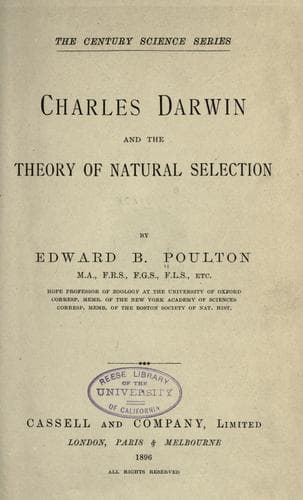
Charles Darwin and the Theory of Natural SelectionPoulton, Edward Bagnall, Sir
Science
Charles Darwin and the Theory of Natural Selection
Poulton, Edward Bagnall, Sir
Darwin, Charles, 1809-1882; Natural selection
The regrowth of an amputated part, as in the salamander or snail,
is explained by the presence and development of gemmules previously
thrown off from the part. The difficulty that a limb is produced of the
same age as that which was lost, and not a larval limb, and that the
cells with which the gemmules must unite at first are not those which
precede them in the course of growth, but mature cells, is met by the
consideration that this power is a special one adapted to meet special
dangers to certain parts of certain animals, and that it is therefore
probable that appropriate provision has been made by natural selection:
it may be in the form of “a stock of nascent cells or of partially
developed gemmules.” The existence of these latter in buds, and their
absence from sexual cells, may account for bud development being the
more direct and brief of the two. The much greater tendency to repair
lost parts in lower and younger forms may be due to the same cause.
The occasional tendency of hybrids to resemble one parent in one part
and the other in another may be due to superabundance of gemmules in
the fertilised germ, those from one parent having “some advantage in
number, affinity, or vigour over those derived from the other parent.”
The general preponderance of one parent over the other may be similarly
explained. The cases in which “the colour or other characters of either
parent tend to appear in stripes or blotches” are to be understood by
the gemmules having an affinity for others of the same kind.
_The sterility of hybrids_ is entirely due to the reproductive organs
being affected; in the case of plants they continue to propagate freely
by buds. The hybrid cells throw off hybrid gemmules which collect in
the buds but cannot do so in the reproductive organs.
_Development and metamorphosis._--The remarkable facts of development
and metamorphosis are well explained by the hypothesis. Allied forms
may pass to a similar end through very dissimilar stages or conversely.
Parts may appear to develop within previously existing corresponding
parts, or they may appear within parts which are quite distinct. These
divergent facts are explained by the hypothesis, each part during each
stage being formed independently from the gemmules of the same part
in previous generations, and not, although it may appear to do so,
from the corresponding parts of earlier stages. In the process of time
certain parts during certain stages may be affected by use or disuse or
surroundings, and the parts of subsequent generations will be similarly
affected, because formed from correspondingly altered gemmules; but
this need not affect the other stages of the same parts.
Public-domain text, read in full here on John Shaqi.
Reviews
Reviews
No reviews yet
Be the first to share your thoughts on this work.
Elsewhere in the archive
Join the Discussion
Join the discussion
Sign in to leave a comment or review.
Sign InorCreate an account