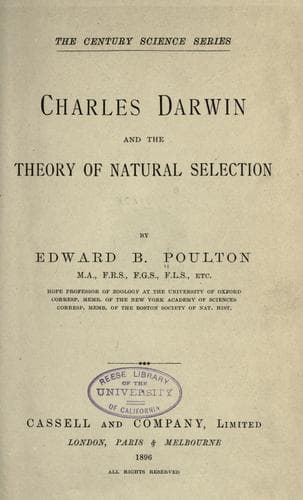
Charles Darwin and the Theory of Natural SelectionPoulton, Edward Bagnall, Sir
Science
Charles Darwin and the Theory of Natural Selection
Poulton, Edward Bagnall, Sir
Darwin, Charles, 1809-1882; Natural selection
Reversion is induced by a change of conditions and especially by
crossing. The first results of crossing are usually intermediate
between the parents, but in the next generation there is commonly
reversion to one or both parent-forms, or even to a more remote
ancestor. The existence of abundant hybridised gemmules is shown by the
propagation of the cross in a true form by means of buds; but dormant
gemmules from the parent-form are also present and multiply. In the
sexual elements of the hybrid there are both pure and hybrid gemmules,
and the addition of the pure gemmules in one sex to those in the other
accounts for the reversion, especially if we assume that pure “gemmules
of the same nature would be especially apt to combine.” Partial
reversion on the one hand, and the reappearance of the hybrid form on
the other, would be respectively due to a combination of pure with
hybrid gemmules, and of the hybrid gemmules from both parent hybrids.
When characters which do not blend exist in the parents, crossing
may result in an insufficiency of gemmules from the male alone and
from the female alone, and then dormant ancestral gemmules might have
the opportunity of development, and thus cause reversion. Similarly
certain conditions might favour the increase and development of
dormant gemmules. Diseases appearing in alternate generations, or
gaining strength by the intermission of a generation, may be due to
the increase of the gemmules in the intervening time, and the same
explanation may hold for the sudden and irregular increase of a weakly
inherited modification.
Darwin ends his general conclusions with these words:--
“No other attempt, as far as I am aware, has been made,
imperfect as this confessedly is, to connect under one point
of view these several grand classes of facts. An organic
being is a microcosm--a little universe, formed of a host of
self-propagating organisms, inconceivably minute and numerous as
the stars in heaven.”
CHAPTER XXII.
PANGENESIS AND CONTINUITY OF THE GERM-PLASM: DARWIN’S CONFIDENCE IN
PANGENESIS.
[Sidenote: PANGENESIS.]
Darwin’s letters prove that he thought very highly of this hypothesis;
and whether the future determine it to be true or erroneous, it must
surely rank as among the greatest of his intellectual efforts. In his
autobiography he says of it:--
“An unverified hypothesis is of little or no value; but if any
one should hereafter be led to make observations by which some
such hypothesis could be established, I shall have done good
service, as an astonishing number of isolated facts can be thus
connected together and rendered intelligible.”
The hypothesis was submitted to Huxley (May 27th, 1865?) in manuscript
and alluded to in the letter sent at the same time. An unfavourable
reply was evidently received, for we find Darwin writing to Huxley,
July 12th (1865?):--
Public-domain text, read in full here on John Shaqi.
Reviews
Reviews
No reviews yet
Be the first to share your thoughts on this work.
Elsewhere in the archive
Join the Discussion
Join the discussion
Sign in to leave a comment or review.
Sign InorCreate an account