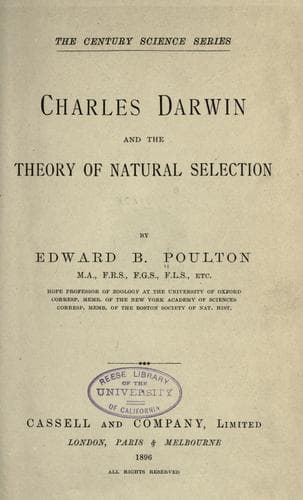
Charles Darwin and the Theory of Natural SelectionPoulton, Edward Bagnall, Sir
Science
Charles Darwin and the Theory of Natural Selection
Poulton, Edward Bagnall, Sir
Darwin, Charles, 1809-1882; Natural selection
“I do not doubt your judgment is perfectly just, and I will try
to persuade myself not to publish. The whole affair is much too
speculative; yet I think some such view will have to be adopted,
when I call to mind such facts as the inherited effects of use
and disuse, &c.”
This last sentence is of great interest, and the same opinion comes
out strongly in his published account of the hypothesis, viz. the
view that the real facts which imperatively demand some material to
pass from the body-cells to the germ-cells in order to account for
their hereditary transmission are the effects of use and disuse, or the
influence of surroundings--in fact, all those characters which are now
called “acquired.” And it is impossible to escape the conclusion that,
if acquired characters are transmissible by heredity, an hypothesis
which is substantially that of pangenesis will have to be accepted.
Darwin did not doubt this transmission, and he framed pangenesis mainly
to account for it.
Considerable doubt has of recent years been thrown upon the
transmission of acquired characters, and if hereafter this doubt
be justified, it will be possible to substitute for pangenesis a
hypothesis like the “continuity of the germ-plasm” brought forward by
Professor Weismann. A few words indicating the contrast between the two
hypotheses may not be out of place.
In Professor Weismann’s hypothesis the germ-plasm contained in the
nucleus of the germ-cell possesses, if placed under right conditions,
the power of developing into an organism. It is not, however, entirely
used up during development, and the part which remains grows and is
stored in the germ-cells of the offspring, and ultimately develops
into the succeeding generation. Hence parent and offspring resemble
each other because they are formed from the same thing. There is no
real break between the generations; they are thrown up successively
from a continuous line of germ-plasm. In this hypothesis the germ
is the essential thing, the body a mere secondary product. It is a
theory of Blastogenesis as contrasted with Pangenesis. The hereditary
transmission of acquired characters, in which many still believe, is
quite irreconcilable with it, and if substantiated would overthrow it
altogether.
On the other hand the body-cells are the essential elements of
pangenesis, and the germ-cells the mere meeting-places of their
representatives and quite devoid of significance on their own account.
There is some sort of interruption between successive generations, as
the gemmules develop into cells, which again throw off gemmules; the
break, however, is bridged by the ancestral gemmules and by the life of
the body-cell which intervenes between the gemmule from which it arose
and that to which it gives rise.
Public-domain text, read in full here on John Shaqi.
Reviews
Reviews
No reviews yet
Be the first to share your thoughts on this work.
Elsewhere in the archive
Join the Discussion
Join the discussion
Sign in to leave a comment or review.
Sign InorCreate an account