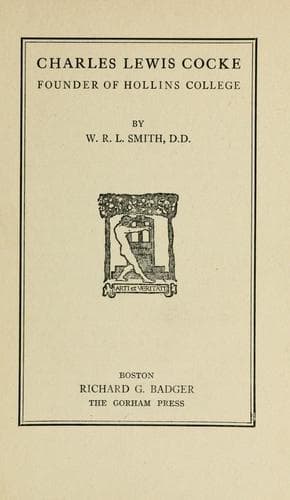
Charles Lewis Cocke, Founder of Hollins CollegeSmith, William Robert Lee
History
Charles Lewis Cocke, Founder of Hollins College
Smith, William Robert Lee
Cocke, Charles Lewis, 1820-1901; Hollins College
Now, the President knew that his assistant was romantically entangled
with an affair of the heart. He also knew the fair young woman who was
responsible for that state of things. Miss Susanna V. Pleasants lived
five miles north of Richmond in a lovely old Virginia home which bore
the Indian name of "Picquenocque." Knowing that a matrimonial alliance
was imminent, the Doctor, one day, ventured to ask Charles about the
date of the coming event. He warmly approved the match and was exuberant
in congratulations. As a matter of fact he was hoping that the marriage
would tend to fix his assistant more firmly in Richmond College. This
genial intrusion into sacred privacy was not resented, but Charles found
it inconvenient to confide. The question was asked in November, and at
that very moment the issue to be decided between the sweethearts was
whether the ceremony should come off on the last day of December, or the
first of January following. That problem enabled the young gentleman to
make a complete but truthful evasion. His honest reply was: "I know
neither the day, nor the month, nor the year." There the matter ended,
and the mystified Doctor relapsed into silence. Later the mighty problem
was solved and the marriage was solemnized on the last day of 1840.
Doctor Ryland, officiating, beamed on the happy pair and found great
merriment in the perfectly true, but dextrously non-committal answer,
made just six weeks before. The bride and groom had not quite reached
their twenty-first birthdays when they began that remarkable human
pilgrimage which was to endure a little more than sixty years. The
angels of domestic peace and joy sang benediction all the way. That home
life is a glorious memory now, but its lesson is more precious than
gold. An astronomer discerned a luminous star. On closer inspection he
found it, not single but binary. The twin stars joined their radiance,
which came streaming down in one glorious pencil of light. Such a star
beams forever in the Hollins firmament.
CHAPTER II
CALL OF THE SOUTHWEST
1846-1856
The attraction of the Blue Ridge and Alleghany mountains was a fact
freely confessed by eastern Virginians. Even before the Revolutionary
War the section, now known as the Tazewell country, became an Eldorado,
and thitherward set the streams of migration. Along the beautiful
valleys and in the hearts of the hills lay the possibilities of fabulous
wealth. Through the early decades of the nineteenth century this
fascination continued, population increased, centers of culture were
formed, and men of enterprise began to think of a railroad from
Lynchburg, Virginia, to East Tennessee. Christian evangelism was active,
but education lagged. There were fine brains in the Southwest, but the
means of culture were deficient. The land called for the school teacher.
Slowly the providential workings were preparing a place for a young
professor in Richmond College, who as yet had no dream of it.
Public-domain text, read in full here on John Shaqi.
Reviews
Reviews
No reviews yet
Be the first to share your thoughts on this work.
Join the Discussion
Join the discussion
Sign in to leave a comment or review.
Sign InorCreate an account