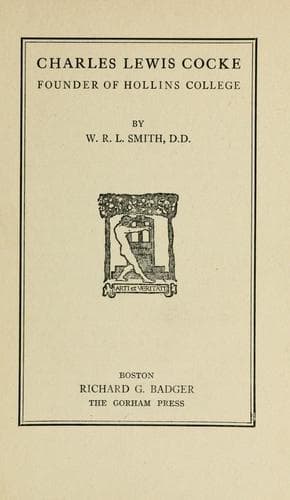
Charles Lewis Cocke, Founder of Hollins CollegeSmith, William Robert Lee
History
Charles Lewis Cocke, Founder of Hollins College
Smith, William Robert Lee
Cocke, Charles Lewis, 1820-1901; Hollins College
CHARLES LEWIS COCKE AND SUSANNA VIRGINIA PLEASANTS, ABOUT 1840 30
THE VALLEY UNION SEMINARY, 1842-1852 36
THE FEMALE SEMINARY AT BOTETOURT SPRINGS, 1852-1855 46
HOLLINS INSTITUTE 60
MRS. CHARLES L. COCKE 70
"GOOD MORNING, 'GYRLS'" 92
CHARLES L. COCKE 132
MRS. CHARLES L. COCKE 142
MRS. ANNE HOLLINS 150
JOHN HOLLINS 154
HOLLINS COLLEGE 160
INTRODUCTION
This biographical sketch of Charles L. Cocke has been written with fine
appreciation and sympathy. It brings before us an exceptionally strong
man, who after years of struggle against discouragements realized, in
large measure, the ideals of his early years. It is a story of heroic
achievement that can not be read without emotion.
Hollins College stands today as a fitting and permanent memorial of its
founder's indomitable will and noble aims. But there was something still
finer connected with his years of struggle and toil. Long before the end
came, he had made the noblest achievement of human life, bringing from
its disappointments and conflicts, not a cynical distrust of his fellow
men, but a courageous, hopeful and invincible character of righteousness
and love. He learned to look upon the tumultuous world with a serene and
benignant spirit.
It was my privilege for many years to serve as one of the chaplains of
Hollins College. The hours spent in Mr. Cocke's office after the evening
service are among my cherished memories. Our talk, often protracted
till nearly midnight, turned chiefly on educational, religious, and
social subjects, which always made a strong appeal to his vigorous mind
and earnest nature. He loved the truth; but in the expression of his
opinions there was sometimes a delightful touch of exaggeration that
lent a peculiar charm to his conversation.
Beyond any man I have ever known he possessed the power to call forth
noble sentiment and stimulate intellectual activity. This quality
explains, in part at least, the loyal devotion of his co-workers and the
grateful affection of his students. It made him a great teacher. It
endowed him with a sort of divine right to leadership; it crowned him
with the glory of perennial, unconscious beneficence.
Public-domain text, read in full here on John Shaqi.
Reviews
Reviews
No reviews yet
Be the first to share your thoughts on this work.
Join the Discussion
Join the discussion
Sign in to leave a comment or review.
Sign InorCreate an account