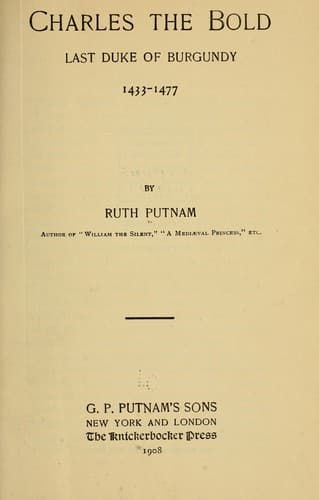
Charles the Bold, Last Duke of Burgundy, 1433-1477Putnam, Ruth
History
Charles the Bold, Last Duke of Burgundy, 1433-1477
Putnam, Ruth
Burgundy (France) -- History; Charles, Duke of Burgundy, 1433-1477; Switzerland -- History -- 1032-1499
Flanders and Artois, together with the duchy and county of Burgundy,
came to him from his father, John the Fearless, in 1419. In 1421, he
bought Namur. In 1430, he declared himself heir to his cousins in
Brabant and Limbourg when Duke Anthony's second son followed his
equally childless brother into a premature grave, and the claims were
made good in spite of all opposition. Holland, Zealand, and Hainaut
became his through the unwilling abdication of his other cousin,
Jacqueline, in 1433. To save the life of her husband, Frank van
Borselen, the last representative of the Bavarian House then
formally resigned her titles, which she had already divested of all
significance five years previously, when Philip of Burgundy had become
her _ruward_, to relieve a "poor feminine person" of a weight of
responsibility too heavy for her shoulders.[21]
Divers items in the accounts show what Philip expended in having
the titles of Holland, Zealand, and Hainaut added to his other
designations. Also there were various places where his predecessor's
name had to be effaced to make room for his. (Laborde, i., 345).]
Antwerp and Mechlin were included in Brabant. Luxemburg was a later
acquisition obtained through Elizabeth of Görlitz.
There were very shady bits in the chapters about Philip's entry into
many of his possessions, but it is interesting to note how cleverly
the best colour is given to his actions by Olivier de la Marche and
other writers who enjoyed Burgundian patronage. Very gentle are the
adjectives employed, and a nice cloak of legality is thrown over the
naked facts as they are ushered into history. Contemporary criticism
did occasionally make itself heard, especially from the emperor, who
declared that the Netherland provinces must come to him as a lapsed
imperial fief. For a time Philip denied that any links existed between
his domain and the empire, but in 1449 he finally found it convenient
to discuss the question with Frederic III. at Besançon; still he never
came to the point of paying homage.
All these territories made a goodly realm for a mere duke. But
they were individual entities centred around one head with little
interconnection.
Philip thought that the one thing needed to bring his possessions into
a national life, as coherent as that of France, was a unity of legal
existence among the dissimilar parts, and the effort to attain this
unity was the one thought dominating the career of his successor,
whose pompous introduction to life naturally inspired him with a high
idea of his own rank, and led him to dream of greater dignities for
himself and his successor than a bundle of titles,--a splendid, vain,
fatal dream as it proved.
Public-domain text, read in full here on John Shaqi.
Reviews
Reviews
No reviews yet
Be the first to share your thoughts on this work.
Join the Discussion
Join the discussion
Sign in to leave a comment or review.
Sign InorCreate an account