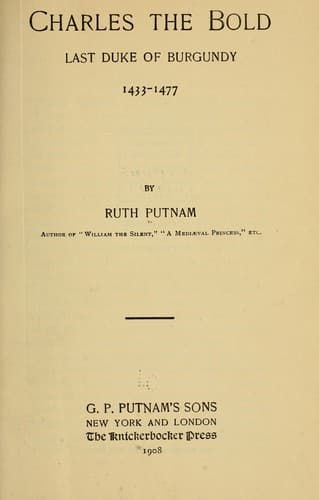
Charles the Bold, Last Duke of Burgundy, 1433-1477Putnam, Ruth
History
Charles the Bold, Last Duke of Burgundy, 1433-1477
Putnam, Ruth
Burgundy (France) -- History; Charles, Duke of Burgundy, 1433-1477; Switzerland -- History -- 1032-1499
"The perron on the market-place of the said town shall be taken
down, and then Monseigneur the duke shall treat it according to
his pleasure. The city may not remake the said perron, nor replace
another like it in the market-place or elsewhere in the city. Nor
shall the said perron appear in the coat-of-arms of Liege."[8]
This was a terrible indignity for the city and a clear proof of their
fear of their bishop's friend.
The episode impressed the citizens of Ghent with the duke's power, and
made the more timorous anxious to erase the event of 1467 from his
mind. The peace party finally prevailed in their arguments, but the
scene of abnegation and self-humiliation crowning their apology was
not enacted until eighteen months after the events apologised for,
when the new duke had still further proven his metal.
[Footnote 1: Gachard, _Doc. inéd_., i., 210, etc.]
[Footnote 2: Some authorities make this five A.M., but the _Rapport_
is probably correct.]
[Footnote 3: Chastellain, v., 260 _et passim_.]
[Footnote 4: So say some historians. But it seems probable that the
drapery of St. Lievin's shrine was hastily used as a flag.]
[Footnote 5: Chastellain, v., ch. 7, etc.]
[Footnote 6: These are Chastellain's words to be sure, but the sober
_Rapport_ is similar in purport.]
[Footnote 7: Gachard, _Doc. inéd._, i., 212. ]
[Footnote 8: Gachard. _Doc. inéd_., ii., 462, "_Instrument notarié_."]
CHAPTER X
THE DUKE'S MARRIAGE
1468
For many months before Philip's death there had been negotiations
concerning Charles's marriage with Margaret of York. Always feeling a
closer bond with his mother than with his father, Charles's sympathy
had ever been towards the Lancastrian party in England, the family to
whom Isabella of Portugal was closely related. Only the necessity for
making a strong alliance against Louis XI. turned him to seek a bride
from the House of York. It was on this business that La Marche and
the great Bastard were engaged when Philip's death interrupted the
discussion, which Charles did not immediately resume on his own
behalf.
Pending the final decision in regard to this important indication of
his international policy, the duke busied himself with the adjustment
of his court, there being many points in which he did not intend to
follow his father's usage.[1] Philip's lavishness, without too close
a query as to the disposition of every penny, was naturally very
agreeable to his courtiers. There was a liberal air about his
households. It was easy to come and go, and it was pleasant to have
the handling of money and the giving of orders--orders which were
fulfilled and richly paid without haggling. Charles had other notions.
He was willing to pay, but he wanted to be sure of an adequate
return. How he started in on his administration with reform ideas is
delightfully told by Chastellain.[2]
Public-domain text, read in full here on John Shaqi.
Reviews
Reviews
No reviews yet
Be the first to share your thoughts on this work.
Elsewhere in the archive
Join the Discussion
Join the discussion
Sign in to leave a comment or review.
Sign InorCreate an account