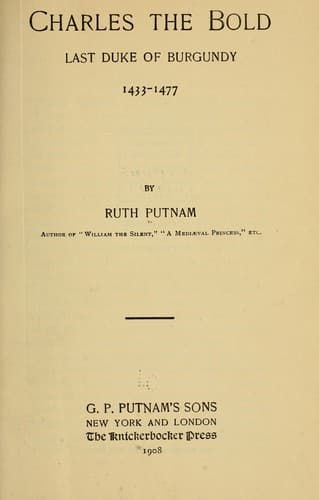
Charles the Bold, Last Duke of Burgundy, 1433-1477Putnam, Ruth
History
Charles the Bold, Last Duke of Burgundy, 1433-1477
Putnam, Ruth
Burgundy (France) -- History; Charles, Duke of Burgundy, 1433-1477; Switzerland -- History -- 1032-1499
Charles simply did not dare attempt further coercion of the democratic
spirit until he was beyond the walls. It is evident that he was
completely taken by surprise at Ghent's attitude towards him, as the
city had always professed great personal attachment to him. But there
was a difference between being heir and sovereign. The agreement was
signed, with a mental reservation on the part of the Duke of Burgundy.
He only intended to keep his pledge until he could see his way clear
to make terms better to his liking.
On Tuesday, June 30th, Charles left Ghent, taking his daughter and his
treasure away, but a safe shelter for both was not easy to find.
The duke's anticipations of the effect of Ghent's actions upon her
neighbours were quickly proved to be no idle fears. There were revolts
of more or less importance at Mechlin, at Antwerp, at Brussels, and
other places. Moreover, there was serious discussion in the estates
assembled at Louvain as to whether Charles should be acknowledged as
Duke of Brabant, or whether the claims of his cousin, the Count of
Nevers, should be considered as heir to Philip's predecessor, for the
late duke's title had never been considered perfect.
Louis XI. seized the opportunity to urge the pretensions of the
latter, and there were many reasons to recommend him, in the
estimation of the Brabanters, who saw advantage in having a sovereign
exclusively their own, instead of one with the widespread geographical
interests of the Burgundian family. The final decision was, however,
for Charles; a notice of the resolution of the deputies was sent to
him at Mechlin, and he made his formal "entry" into Louvain, where he
received homage from the nobles, the good cities, and the university.
The various insurgent manifestations were promptly quelled one after
another, but, with a nature that neither forgot nor forgave, the duke
was strongly impressed by them as personal insults. He blamed Ghent
for their occurrence and deeply resented every one. Throughout
Philip's whole career he remembered the localised tenure of his titles
and the fact that they were not perfectly incontestable. For his own
advantage he often found a conciliatory attitude the best policy.
Charles considered all his rights heaven-born. Questioning his
authority was rank rebellion. That he had accepted advice in regard
to Ghent, and had been ruled by expediency for the nonce, did not
mitigate his intense bitterness.
In another town that gave him serious trouble at this time, nothing
led him to curb the severity of his measures. Though only a
"protector," not an overlord, when he suppressed a rebellion in Liege
he rigorously exacted the most complete and humiliating penalties. The
city charters were abrogated, all privileges were forfeited. As
an unprotected village must Liege stand henceforth, walls and
fortifications rased to the ground.
Public-domain text, read in full here on John Shaqi.
Reviews
Reviews
No reviews yet
Be the first to share your thoughts on this work.
Elsewhere in the archive
Join the Discussion
Join the discussion
Sign in to leave a comment or review.
Sign InorCreate an account