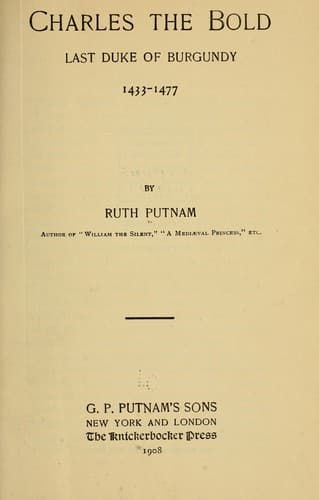
Charles the Bold, Last Duke of Burgundy, 1433-1477Putnam, Ruth
History
Charles the Bold, Last Duke of Burgundy, 1433-1477
Putnam, Ruth
Burgundy (France) -- History; Charles, Duke of Burgundy, 1433-1477; Switzerland -- History -- 1032-1499
[Footnote 4: Dordrecht was not among them. Her deputies held that
it was illegal for them to go to The Hague. Some time later Charles
received the oaths at Dordrecht. (Wagenaar, _Vaderlandsche Hist._,
iv., 101.]
[Footnote 5: Treaty of Ancenis, September 10, 1468. _See_ Lavisse,
iv^[ii].] One of the results of the War of Public Weal was that St.
Pol was appointed constable of France.]
[Footnote 6: The original is in the Mss. de Baluze, Paris, Bibl. Nat.;
Lenglet, iii., 19.]
[Footnote 7: Commines and a letter to the magistrates of Ypres are the
basis of this narrative. (Gachard, _Doc. inéd._, i., 196.) There
is, however, a mass of additional material both contemporaneous and
commentating. _See also_ Michelet, Lavisse, Kirk, etc. Chastellain's
MS. is lost.]
[Footnote 8: _See_ Lavisse, iv^[ii]., 397.]
[Footnote 9: Ludwig v. Diesbach, (_See_ Kirk, i., 559.) The author
was a page in Louis's train, who afterwards played a part in Swiss
affairs.]
[Footnote 10: It was never captured until Wellington took it in 1814.]
[Footnote 11: Commines, ii., ch. vii.]
[Footnote 12: The bishop did indeed meet his death at the hands of the
mob, but it was many years later.]
[Footnote 13: _Le roi ... se voyait logé, rasibus d'une grosse tour ou
un Comte de Vermandois fit mourir un sien prédécesseur Roy de France_.
(Commines, ii., ch. vii.)]
[Footnote 14: _Memoires_, ii., ch. ix.]
[Footnote 15: Undoubtedly Commines wishes it to be inferred that this
was he. The main narrative followed here is Commines, whose memoirs
remain, as Ste.-Beuve says, the definitive history of the times. There
are the errors inevitable to any contemporary statement. Meyer, to be
sure, says, apropos of an incident incorrectly reported, _Falsus in
hoc ut in pluribus historicus_. Kervyn de Lettenhove three centuries
later is also severe. _See_, too, "L'autorité historique de Ph. de
Commynes," Mandrot, _Rev. Hist_., 73.]
[Footnote 16: Gachard, _Doc. inéd._, i., 199.]
[Footnote 17: _Ibid._, 200.]
[Footnote 18: _Waer ic certiffiere dat het dezen nacht niet wel claer
ghestaen heeft._]
[Footnote 19: _Lettres de Louis XI_, iii., 289. The king apparently
never resented the part played by Dammartin when he was dauphin. His
letters to him are very intimate.]
[Footnote 20: _Lettres_, iii., 295. (Toussaint is probably Toustain.)]
[Footnote 21: Kervyn ed., _Oeuvres de Chastellain_, vii., xviii. _See_
poem, _ibid._, 423. The MS. in the Laurentian Library at Florence
bears this line: "Here follows a mystery made because of the said
peace of good intention in the thought that it would be observed by
the parties." Hesdin is, however, a long way out of the route between
Peronne and Namur, where the party was on October 14th. It would
hardly seem possible for journey and visit in so brief a time.]
CHAPTER XII
AN EASY VICTORY
1468
Public-domain text, read in full here on John Shaqi.
Reviews
Reviews
No reviews yet
Be the first to share your thoughts on this work.
Elsewhere in the archive
Join the Discussion
Join the discussion
Sign in to leave a comment or review.
Sign InorCreate an account