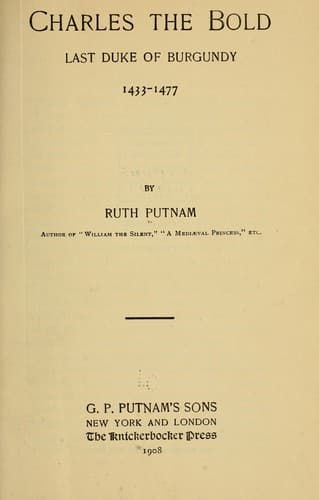
Charles the Bold, Last Duke of Burgundy, 1433-1477Putnam, Ruth
History
Charles the Bold, Last Duke of Burgundy, 1433-1477
Putnam, Ruth
Burgundy (France) -- History; Charles, Duke of Burgundy, 1433-1477; Switzerland -- History -- 1032-1499
It was in the midst of heavy rains that the journey was made to Namur
and then on to the environs of Liege. Grim was the weather, befitting,
in all probability, Charles's own mood. The king's escort was confined
to very few besides the Scottish guard, but a body of three hundred
troopers was permitted to follow him at a distance, while the faithful
Dammartin across the border kept himself closely informed of every
incident connected with the march that his scouts could gather, and
in readiness to fall upon Burgundian possessions at a word of alarm,
while he restrained his ardour for the moment in obedience to Louis's
anxious command.
By the fourth week of October the Franco-Burgundian party were settled
close to Liege in straggling camps, separated from each other by hills
and uneven ground. Long was the discussion in council meeting as to
the best mode of procedure. Liege was absolutely helpless in the face
of this coalition. Wide breaches made her walls useless. Moats she had
never possessed, for digging was well-nigh impossible on her rocky
site covered by mud and slime from the overflow of the Meuse. On
account of this evident weakness, the king advised dismissing half the
army as needless, advice that was not only rejected immediately but
which excited Charles's doubts of the king's good faith. Over a week
passed and feeble Liege continued obstinate, while each division of
the army manoeuvred to be first in the assault for the sake of the
plunder. But advance was very difficult, for the soldiers were
impeded in their movements by the slime. Wild were some of the night
skirmishes over the uneven, slippery ground and amidst the little
sheltering hills.
On one occasion, "a great many were hurt and among the rest the Prince
of Orange (whom I had forgotten to name before), who behaved that day
like a courageous gentleman, for he never moved foot off the place he
first possessed.
The duke, too, did not lack in courage but he failed sometimes
in order giving, and to say the truth, he behaved himself not so
advisedly as many wished because of the king's presence."[1]
There is no doubt that Charles entertained increasingly sinister
suspicions of his guest. He thought the king might either try to enter
the city ahead of him and manage to placate his ancient allies by a
specious explanation, or else he might succeed in effecting his escape
without fulfilling his compact. At last Charles appointed Sunday,
October 30th, for an assault. On the 29th, his own quarters were in
a little suburb of mean, low houses, with rough ground and vineyards
separating his camp from the city. Between his house and that of the
king, both humble dwellings, was an old granary, occupied by a picked
Burgundian force of three hundred men under special injunctions to
keep close watch over the royal guest and see that he played no sudden
trick. To further this purpose of espionage, they had made a breach in
the walls with heavy blows of their picks.
Public-domain text, read in full here on John Shaqi.
Reviews
Reviews
No reviews yet
Be the first to share your thoughts on this work.
Elsewhere in the archive
Join the Discussion
Join the discussion
Sign in to leave a comment or review.
Sign InorCreate an account