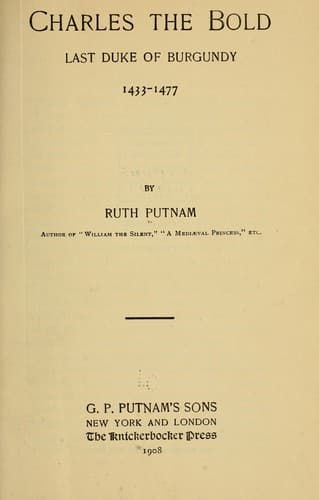
Charles the Bold, Last Duke of Burgundy, 1433-1477Putnam, Ruth
History
Charles the Bold, Last Duke of Burgundy, 1433-1477
Putnam, Ruth
Burgundy (France) -- History; Charles, Duke of Burgundy, 1433-1477; Switzerland -- History -- 1032-1499
Within, the great hall of the palace showed a splendid setting for a
brilliant assembly. The most famous Burgundian tapestries hung on the
walls. Episodes from the careers of Alexander, of Hannibal, and of
other notable ancients formed the background for the duke and his
nobles, knights of the Golden Fleece, in festal array. As spectators,
too, there were all the envoys and ambassadors then present in
Brussels from "France, England, Hungary, Bohemia, Naples, Aragon,
Sicily, Cyprus, Norway, Poland, Denmark, Russia, Livornia, Prussia,
Austria, Milan, Lombardy, and other places."
Charles himself was installed grandly on a kind of throne, and to his
feet Olivier de la Marche conducted the civic procession of penitents.
Before this pompous gathering, after a statement of the city's sin and
sorrow, the precious charter called the Grand Privilege of Ghent
was solemnly read aloud, and then cut up into little pieces with a
pen-knife. Next followed a recitation of the penalties imposed upon,
and accepted by, the citizens (closing of the gates, etc)., and then
the paternal Count of Flanders, duly mollified, pronounced the fault
forgiven with the benediction, "By virtue of this submission and by
keeping your promises and being good children, you shall enjoy our
grace and we will be a good prince." "May our Saviour Jesus Christ
confirm and preserve this peace to the end of this century," is the
pious ejaculation with which the _Relation_ closes.
Among the witnesses of the above scene, when the independent citizens
of Ghent meekly posed as the duke's children, were envoys from George
Podiebrad, ex-king of Bohemia. Lately deposed by the pope, he was
seeking some favourable ally who might help him to recover his realm.
He had conceived a plan for a coalition between Bohemia, Poland,
Austria, and Hungary to present a solid rampart against the Turks,
and strong enough to dictate to emperor and pope. He was ready for
intrigue with any power and had approached Louis XI. and Matthias
Corvinus, King of Hungary, before turning to Charles of Burgundy.[2]
Meantime, the Emperor Frederic tried to knit links with this same
Matthias by suggesting that he might be the next emperor, assuring
him that he could count on the support of the electors of Mayence, of
Trèves, and of Saxony. He himself was world-weary and was anxious to
exchange his imperial cares for the repose of the Church could he
only find a safe guardian for his son, Maximilian, and a desirable
successor for himself. Would not Matthias consider the two offices?
Public-domain text, read in full here on John Shaqi.
Reviews
Reviews
No reviews yet
Be the first to share your thoughts on this work.
Elsewhere in the archive
Join the Discussion
Join the discussion
Sign in to leave a comment or review.
Sign InorCreate an account